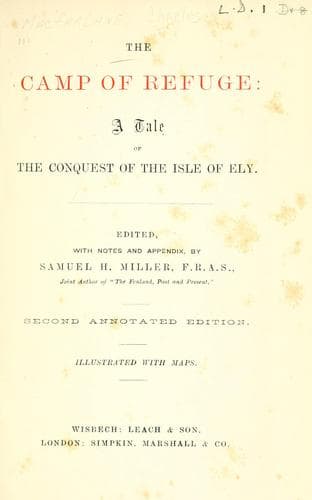
The Camp of Refuge: A Tale of the Conquest of the Isle of ElyMacFarlane, Charles
History
The Camp of Refuge: A Tale of the Conquest of the Isle of Ely
MacFarlane, Charles
Great Britain -- History -- Medieval period, 1066-1485 -- Fiction
Now, we have said it, William the Norman was a great and cunning
commander (ye might have searched through the world at that time, and
have found none greater!), and being thus skilled, and having a
fearless heart withal, and a sort of lion magnanimity, he was proper to
judge of the skill of other captains, and not incapable of admiring and
lauding that skill even in an enemy. And as from his causeway (even as
from a ship in the midst of the waters) he watched the defences which
Hereward raised, and all the rapid and wise movements he made, he
ofttimes exclaimed, “By the splendour! this Saxon is a right cunning
captain! It were worth half a realm could I win him over to my service.
But, O Hereward, since thou wilt not submit, thou must perish in thy
pride through hunger, or in the meshes which I am spreading for thee.”
CHAPTER XXI.
THE MONKS OF ELY COMPLAIN AND PLOT.
As no corn came, and no wine could be had, the tribulations and
murmurings in the monastery grew louder and louder. Certain of the
monks had never looked with a friendly eye upon Girolamo the
Salernitan, but now there was suddenly raised an almost universal
clamour among them that that dark-visaged and thin-bodied alien was,
and ever had been, a necromancer. Unmindful of the many services he had
done, and forgetting how many times they had, when the drinking-horns
could be well filled, rejoiced and jubilated at his successes, and
_specialiter_ on that not far by-gone day when he had burned the Norman
witch, in the midst of her incantations, with the reeds and grass of
the fen, the monks now called him by the foulest and most horrible of
all names, and some of them even called out for his death. These men
said that if Girolamo were brought to the stake and burned as he had
burned the Norman witch, the wrath of Heaven would be appeased, and
matters would go much better with the house of St. Etheldreda, and with
all the English people. Albeit they all knew how innocently those
devils had been made; and, albeit they had seen with their own eyes,
that Girolamo was constant at prayers, mass, and confession, and that
he never prepared his mixtures and compounds until after prayer and
long fasting (to say nothing of his frequently partaking in the
Sacrament of our Lord’s Supper), they rumoured, even like the Normans,
that he had raised devils, and employed fen-fiends, and incubuses, and
succubuses, and had lit hell-fires upon the pools and within the holy
house at Crowland; that he was ever attended by a demon, called by him
Chemeia;[212] that he had been a Jew, and next a follower of
Mahound;[213] that he had sold his soul to the devil of devils at
Jerusalem or Mecca: that he did not eat and drink like Saxons and
Christians, only because he went to graves and charnel-houses at the
dead of night, and feasted upon the bodies of the dead with his fiends
and hell-hounds—with a great deal more too horrible and obscene to
mention.[214]
Public-domain text, read in full here on John Shaqi.
Reviews
Reviews
No reviews yet
Be the first to share your thoughts on this work.
Elsewhere in the archive
Join the Discussion
Join the discussion
Sign in to leave a comment or review.
Sign InorCreate an account