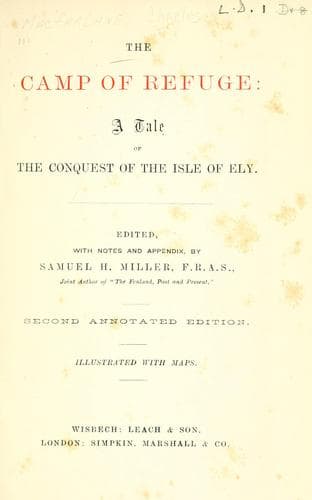
The Camp of Refuge: A Tale of the Conquest of the Isle of ElyMacFarlane, Charles
History
The Camp of Refuge: A Tale of the Conquest of the Isle of Ely
MacFarlane, Charles
Great Britain -- History -- Medieval period, 1066-1485 -- Fiction
upon ransom, and was again making himself terrible), give up the cause
of Lord Hereward, who had restored them to their house, and had given
up wealth and honours abroad to come and serve his country, and submit
like peaceable subjects to _King_ William, whose power was too great to
be any longer disputed. But here, at Crowland, these things were for a
long time said in great secrecy, and whispered in the dormitories by
night. It was the same in the succursal cell at Spalding; and the
coming danger was the greater from the secrecy and mystery of the
traitorous part of these communities. Father Adhelm, the good prior of
Spalding, knew of no danger, and could believe in no treachery until
the Philistines were upon him; and it was mainly owing to this his
security, and to his representations of the safety of that corner of
the fens, that the Lord of Brunn sent his wife and infant son,[211]
with maid Mildred and other women, to dwell in the strong manor-house
at Spalding, which belonged to the Ladie Lucia, wife of Ivo
Taille-Bois, and cousin to the Ladie Alftrude. The Camp of Refuge and
the town of Ely had not, for some time past, been fitting
abiding-places for ladies and delicate children; but now the Normans
were closing in their line of blockade on that side, and, although they
meant it not, they seemed to be on the eve of making a desperate
assault on the Camp, having, with incredible labour, laid down under
the eyes and with the direction of Duke William, another causeway,
which was far broader and more solid than any of the others, and which
ran across the fens towards the waters of Ely for the distance of two
well-measured miles. It was Elfric that commanded the party which gave
convoy to the Ladie Alftrude; and well we wot he wished the journey had
been a longer one: yet when his duty was done, and the whole party
safely lodged in the battlemented and moated house at Spalding, he
quitted maid Mildred, though with something of a heavy heart, and
hastened back to join his toil-oppressed master. And careworn and
toil-oppressed indeed was now that joyous and frank-hearted Lord of
Brunn, for he had to think of everything, and to provide for
everything; and save in Girolamo the Salernitan, and Elfric his
armour-bearer, he had but few ready-witted men to aid him in his
increasing difficulties. Nevertheless, the defences at the Witchford
were strengthened, numerous trenches and canals were dug to render the
Witch plain impassable, even if the river should be crossed, and bands
of Saxons, armed with bows, bills, pole-axes, swords, and clubs, or
long fen-poles, were kept on the alert by night as well as by day, to
march to any point which the Normans might attack.
Public-domain text, read in full here on John Shaqi.
Reviews
Reviews
No reviews yet
Be the first to share your thoughts on this work.
Elsewhere in the archive
Join the Discussion
Join the discussion
Sign in to leave a comment or review.
Sign InorCreate an account