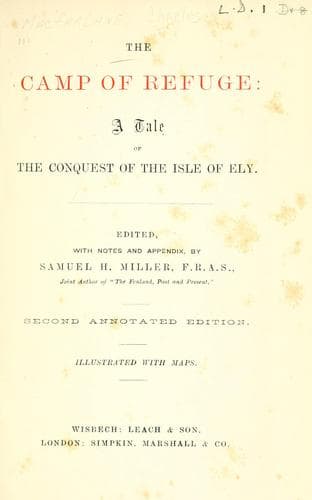
The Camp of Refuge: A Tale of the Conquest of the Isle of ElyMacFarlane, Charles
History
The Camp of Refuge: A Tale of the Conquest of the Isle of Ely
MacFarlane, Charles
Great Britain -- History -- Medieval period, 1066-1485 -- Fiction
It was at this juncture of time that two pretended pilgrims and
devotees of Saint Etheldreda arrived at the guest-house of Ely, giving
out that they had with great risk and real danger found their way
through the lines of the beleaguering Normans, but that, so entire was
their devotion to the saint, no perils could prevent them from coming
to the shrine. It was not much noted at the time, but it was well
remembered afterwards, and when it was all too late, that these two
palmers spent much more of their time in walking and talking outside
the abbey walls with the prior and the chamberlain, than in the praying
inside the church and in the chapel of the saint: that they seemed to
shun the Lord Abbat, and that they took their departure in a sudden
manner, and without taking leave of the Abbat as good pilgrims were
wont to do. And almost immediately after the departure of the two false
palmers, a proclamation was made by sound of trumpet and by Duke
William’s orders, that the Abbat of Ely, having leagued himself with a
sorcerer (having long before leagued himself with traitors and rebels
and robbers), had incurred the anathemas of the church, which would
soon be pronounced upon him by bell, book, and candle,[217] and with
all the formalities in use. And after this had been proclaimed by sound
of trumpet in the Camp, and at the cross of the town of Cam-Bridge, and
at the crosses of Peterborough, Huntingdon, Stamford, and many other
towns, the cloister-monks most adverse to the Lord Abbat began to throw
off all secrecy and disguise, and to talk as loud as trumpets both in
the streets of Ely and in the monastery, calling Girolamo a sorcerer
and worse. Upon this the dark Salernitan came up from the Camp to the
monastery, and demanded to be heard in the church or in the hall, in
the presence of the whole house. Thurstan, with right good will,
assented; and although some of the monks tried to oppose it, Girolamo
was admitted to plead his own defence and justification in the great
hall. It was the envious prior’s doing, but the novices and all the
younger monks were shut out, for the prior feared greatly the effect of
the speech of the Salernitan, who by this time had made himself master
of the Saxon tongue, while in the Latin tongue and in Latin quotations,
Girolamo had few equals on this side the Alps. He presented himself
alone, having forcibly and successfully opposed the Lord Hereward, who
would fain have accompanied him to the abbey. “If you should be with
me,” he had said to the Lord of Brunn, “they will impute it to me, in
case of my effacing these vile stigmas, that I have been saved by your
favour and interference, or by the respect and awe which is due to you,
or by the dread they entertain of your arms; and should I fail in my
defence, they might afterwards work you great mischief by representing
you as mine advocate. No! good my Lord, alone will I stand upon my
defence, and bring down confusion upon these calumniators!”
Public-domain text, read in full here on John Shaqi.
Reviews
Reviews
No reviews yet
Be the first to share your thoughts on this work.
Elsewhere in the archive
Join the Discussion
Join the discussion
Sign in to leave a comment or review.
Sign InorCreate an account