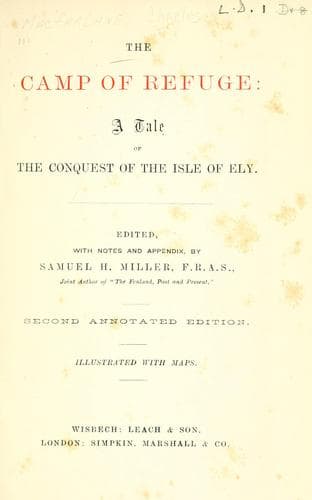
The Camp of Refuge: A Tale of the Conquest of the Isle of ElyMacFarlane, Charles
History
The Camp of Refuge: A Tale of the Conquest of the Isle of Ely
MacFarlane, Charles
Great Britain -- History -- Medieval period, 1066-1485 -- Fiction
And thus it was all alone that the dark and thin and sad Salernitan
entered the great hall, in the midst of a coughing and spitting, and an
uplifting and a turning away of eyes, as if the monks felt sulphur in
their gorges, and saw some fearful and supernatural object with their
eyes. Nothing abashed, the Salernitan threw off the black mantle which
he ordinarily wore, and stepping unto the midst of the hall—the monks
being seated all round him—he made the blessed sign of the cross,
threw up his hands for a moment as if in prayer, and then spoke. And
when he first began to speak, although he more immediately faced the
abbat and his friendly honest countenance, his coal-black eyes, which
seemed all of a blaze, rested and were fixed upon the envious false
visage of the prior, who wriggled in his seat, and whose eyes were bent
upon the ground, all unable to encounter the burning glances of that
animated, irate Italian.
“My good Lord Abbat,” said Girolamo, looking as we have said, not at
Thurstan, but at the prior, “what is this horrid thing that I hear?
What are these evil rumours which have been raised against me, while I
have been adventuring my life for the service of this house and the
good Saxon cause?”
“There hath been some idle talk about sortilege, and it grieves me to
say that this idle talk hath of late become very loud in this house,”
responded Thurstan.
“And who be they who first raised this talk?” said Girolamo; “where are
my accusers? Who are the members of this house that have not seen as
well my devotion to Heaven as the earthly and natural and legitimate
means by which I have worked out mine ends for the furtherance of the
good cause? Where are they, that I may speak to them and tell them to
their faces how much they have erred or how greatly they have lied? But
they dare not look me in the face!”
And as he said these words he turned his burning eyes from the prior to
the chamberlain, and then from the chamberlain to another cankerous
monk, and to another, and another, and they all pulled their cowls over
their brows and looked down upon the floor. But at last the chamberlain
found voice and courage enough to raise his head a little; and he said,
“Oh, stranger! since thy first coming amongst us thou hast done things
most strange—so strange that wise and good men have thought they have
seen the finger of the devil in it.”
Public-domain text, read in full here on John Shaqi.
Reviews
Reviews
No reviews yet
Be the first to share your thoughts on this work.
Elsewhere in the archive
Join the Discussion
Join the discussion
Sign in to leave a comment or review.
Sign InorCreate an account