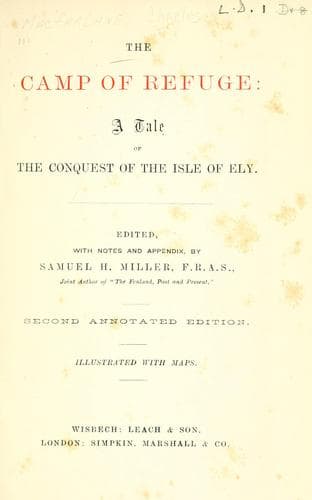
The Camp of Refuge: A Tale of the Conquest of the Isle of ElyMacFarlane, Charles
History
The Camp of Refuge: A Tale of the Conquest of the Isle of Ely
MacFarlane, Charles
Great Britain -- History -- Medieval period, 1066-1485 -- Fiction
that he had thrust his sword right through the thin body of the alien,
had driven the hilt home on his left breast; and that when he withdrew
his sword, instead of falling dead to the earth, the stranger stood
erect, laughing scornfully at him, and losing no blood, and showing no
sign of any wound. Now all these things fortified the belief that the
stranger was the Jew that could not die! Seeing that a deep impression
was made upon many of his hearers who had gone into the hall with the
determination of believing that there had been no magic, and that
nothing unlawful had been done by the defenders of the liberties of the
Saxon people and the privileges of the Saxon church, the cunning prior
turned his attack upon Thurstan. It was notorious, he said, that
Thurstan had been a profuse and wasteful abbat of that house, taking no
thought of the morrow, but feasting rich and poor when the house was at
the poorest; that he was a man that never kept any balance between what
he got and what he gave; and that he had always turned the deaf side of
his head to those discreet brothers the chamberlain, the sacrist, the
cellarer and refectorarius, who had long since foretold the dearth and
famine which the convent were now suffering. [Here nearly every monk
present laid his right hand upon his abdomen and uttered a groan.] It
was known unto all of them, said the prior, that under the rule and
government of Thurstan such things had been done in the house as had
never been done under any preceding abbat. The shrine-boxes had been
emptied; the plates of silver and of gold, the gifts of pious kings and
queens, had been taken from the shrines themselves; the treasure
brought from the abbey of Peterborough had only been brought to be
given up to the Danes and sent for ever from England, together with the
last piece of silver the pilgrims had left in the house of Ely! And
then the Jews! the Jews! Had not dealings been opened with them? Had
not a circumcised crew been brought into the patrimony of Saint
Etheldreda, and lodged in the guest house of the abbey? Had not the
abbat’s seal been used in sealing securities that were now in the hands
of the Israelities? And was not all the money gotten from the Jews gone
long ago, and was not the treasury empty, the granary empty, the cellar
empty,—was there not an universal void and emptiness in all the abbey,
and throughout the patrimony of St. Etheldreda? [The monks groaned
again.] In concluding his long discourse the prior raised his unmanly
voice as high as it could be raised without cracking, and said—“Upon
all and several the indubitable facts I have recited, I accuse this
Girolamo of Salerno of magic and necromancy; and I charge Thurstan,
abbat of this house, and Elfric, whilom novice in the succursal cell of
Spalding, of being defensors, fautors, and abettors of the necromancer.
And what saith the sixteenth of the canons enacted under the pious King
Edgar? And how doth it apply to our abbat? The canon saith this—‘And
Public-domain text, read in full here on John Shaqi.
Reviews
Reviews
No reviews yet
Be the first to share your thoughts on this work.
Elsewhere in the archive
Join the Discussion
Join the discussion
Sign in to leave a comment or review.
Sign InorCreate an account