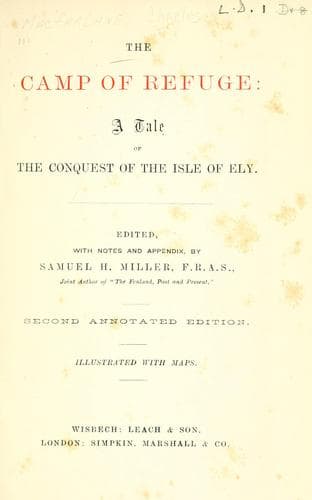
The Camp of Refuge: A Tale of the Conquest of the Isle of ElyMacFarlane, Charles
History
The Camp of Refuge: A Tale of the Conquest of the Isle of Ely
MacFarlane, Charles
Great Britain -- History -- Medieval period, 1066-1485 -- Fiction
we enjoin, that every priest zealously promote Christianity, and
totally extinguish every heathenism; and fordid necromancies and
divinations and enchantments, and the practices which are carried on
with various spells, and with frith-splots and with elders, and also
with various other trees, and with stones, and with many various
delusions, with which men do much of what they should not.’ I have
done.”[219]
For a while there was silence, the monks sitting and gazing at each
other in astonishment and horror. At length, seeing that the abbat was
almost choked, and could not speak at all, Girolamo said, “my lord, may
I begin?”
Thurstan nodded a yea.
Hereupon the Salernitan went over the whole history of his past life,
with all its sorrows, studies, and wanderings; and bade the monks
reflect whether such a life was not fitted to make a man moody and sad
and unlike other men. He acknowledged that, as compared with Saxons,
and more especially with the Saxon monks of Ely, he ate and drank very
little; but this was because his appetite was not good, and his habit
of life very different from theirs. He allowed that he was fond of
wandering about in lonely places, more especially by moonlight, but
this was because eating little he required the less sleep, and because
the sadness of his heart was soothed by solitude and the quiet aspect
of the moon and stars. All this, and a great deal more, the Salernitan
said in a passably composed and quiet voice; but when he came to deny
and refute the charges which the prior had made, his voice pealed
through that hall like thunder, and his eyes flashed like lightning. In
concluding he said—“I was ever a faithful son of Mother Church. The
blessed Pope at Rome—Pope Alexander it was—hath put his hand upon
this unworthy head and given me his benediction. The pious abbat of the
ancient Benedictine house of La Cava that stands in the chasm of the
mountain between Salerno and the city of Neapolis held me at the
baptismal font; cloister-monks were my early instructors, and learned
doctors of the church were my teachers in youth and manhood. I have
been a witch-seeker and a witch-finder in mine own country. Ye have
known me, here, burn, or help to burn, a witch almost under your own
eyes. Jews have I ever abhorred,[220] even as much as witches,
necromancers, and devils! Saracens and Moors, and all that follow
Mahound, have I ever hated as Jews, and as much as good Christians
ought to hate them! Oh prior, that makest thyself my accuser, thou hast
been a home-staying man, and hast not been called upon to testify to
thy faith in the lands where heathens rule and reign, and Mahound is
held to be the prophet of God, and superior to God’s own Son. But I
tell thee, prior, that I have testified to my faith in such places, and
openly on the threshold of Mahound’s temples, braving death and seeking
a happy martyrdom which, alas! I could not find. Saxons! in a town in
Public-domain text, read in full here on John Shaqi.
Reviews
Reviews
No reviews yet
Be the first to share your thoughts on this work.
Elsewhere in the archive
Join the Discussion
Join the discussion
Sign in to leave a comment or review.
Sign InorCreate an account