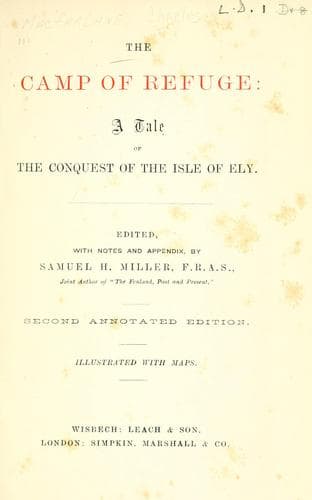
The Camp of Refuge: A Tale of the Conquest of the Isle of ElyMacFarlane, Charles
History
The Camp of Refuge: A Tale of the Conquest of the Isle of Ely
MacFarlane, Charles
Great Britain -- History -- Medieval period, 1066-1485 -- Fiction
Palestine wherein, save a guard of Saracens, there were none but Jews,
I took the chief rabbi by the beard at the gate of his synagogue.
Saxons! to show my faith I have eaten swine’s flesh at Jerusalem, in
the midst of Saracens and Jews. Saxons! in the Christian countries of
Europe I never met an Israelite without kicking him and loading him
with reproaches. Bethink ye then, after all this, whether I, Girolamo
of Salerno, be a Jew, or Mahounder, or necromancer! If ye are weary of
me let me be gone to the country from which I came. I brought little
with me, and shall take still less away. If ye would repay with torture
and death the good I have done ye, seize me now, throw me into your
prison, load me with chains, put me to the rack, do with me what ye
will, but call me not Jew and wizard!”
Sundry of the monks said that the words of the stranger sounded very
like truth and honesty, and that of a surety the good Lord Hereward
would not have brought a wizard with him into England, or have lived so
long in friendship with a necromancer. Others of the cloister-monks,
but they were few in number, said that Girolamo had disproved nothing,
and that it could be but too well proved that woe and want had fallen
upon the good house of Ely—that the treasury, granary, wine-cellar
were all empty. The Lord Abbat now spoke, but his anger had cooled, and
his speech was neither loud nor long. He declared that every man, being
in his senses and not moved by private malice, must be convinced that
the Salernitan was a good believer and no wizard; and that, whatever he
had done, however strange some things might appear, had been done by
means not unlawful. This being the case there could be no sin or blame
in his having made himself the defensor of the stranger, and no sin in
Elfric’s having associated with him, and assisted in his works. “But,”
said the abbat, “though the prior hath not been bold enough to name
that name, ye must all know and feel that, if this man were a
necromancer, charges would lie far more against Hereward, our great
captain, than against me or that poor young man, Elfric. Would ye
accuse the Lord of Brunn of sorcery and witchcraft? I see ye dare not,
nay, I see ye would not!”
As to the daring, Thurstan was right: but as to the will, he was wrong;
for the prior and the chamberlain, and some others, would have accused
Hereward if they had only had courage enough so to do.
Public-domain text, read in full here on John Shaqi.
Reviews
Reviews
No reviews yet
Be the first to share your thoughts on this work.
Elsewhere in the archive
Join the Discussion
Join the discussion
Sign in to leave a comment or review.
Sign InorCreate an account