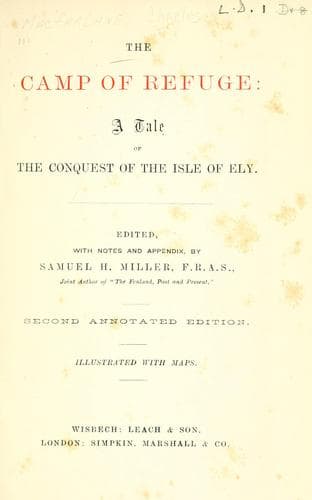
The Camp of Refuge: A Tale of the Conquest of the Isle of ElyMacFarlane, Charles
History
The Camp of Refuge: A Tale of the Conquest of the Isle of Ely
MacFarlane, Charles
Great Britain -- History -- Medieval period, 1066-1485 -- Fiction
There was no cloister-monk of Ely that better knew the legends of the
house than Elfric, for his father, Goodman Hugh, who had dwelt by saint
Ovin’s cross, and his father’s father who had dwelt in the same place,
had been great fenners and fowlers and gossips, and had hawked with the
best of the abbats and monks, and had stored their memories with the
history of the abbey and the saints of Ely, and had amused and
sanctified the long winter-nights, when the fire of wood mixed with
peat burned brightly on their hearth, by relating to little Elfric all
the legends that they knew. Now there was one of these which had made a
profound impression upon Elfric’s mind, which, by nature, loved
adventure and ingenious stratagem. It was a short tale, and simple
withal, and easy to tell.
Saint Withburga, the fourth in order of the four great female saints
that were and are the ornaments and shining lights of the great house,
did not live and die as her sister Saint Etheldreda had done, at Ely,
and as Lady Abbess. In her infancy she was sent to nurse at a village
called Holkham, belonging to the king her father, Anna, king of the
East Angles. In this place she lived many years, whence the village of
Holkham was sometimes called Withburgstowe, and a church was built
there in memory of her. On the death of the king her father, which
befel in the year of grace six hundred and fifty-four, Withburga
removed from Holkham to Dereham, another village in the country of East
Anglia; and here, affecting a retired and religious life, she founded a
monastery of nuns, over which she presided for many years. Peaceful and
holy was her life, and blessed was her end. When she died, they buried
her there, in the churchyard at Dereham.[221] And lo! after many more
years had passed, and the other tenants of this churchyard and even
those that had been buried long after had mouldered into dust, the
grave of Withburga being opened, her body was found entire and without
the slightest sign of corruption! Aye, there she lay in her shroud and
coffin, with her hands crossed upon her breast, and with her little
crucifix of silver lying upon her breast, even as she had lain on the
bier on the day of her death so many, many years before. The saintly
incorruptible body was forthwith removed into the church, where it was
preserved with great care and devotion by the good people of Dereham,
and it continued there, not without manifold miracles, until the time
of that pious monarch King Edgar,[222] who restored the monastery at
Ely, which the Danes had burned, and gave the house that precious
charter which hath been named before as not being given privately and
in a corner, but in the most public manner and under the canopy of
Heaven. Now, in restoring the abbey of Ely to its pristine splendour,
and in augmenting the number of the brotherhood, it behoved the king to
increase the lands and domains of the house; and, conformably, the
Public-domain text, read in full here on John Shaqi.
Reviews
Reviews
No reviews yet
Be the first to share your thoughts on this work.
Elsewhere in the archive
Join the Discussion
Join the discussion
Sign in to leave a comment or review.
Sign InorCreate an account