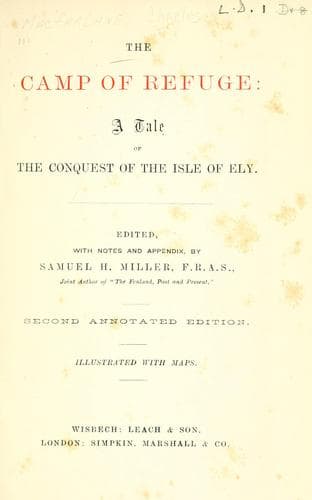
The Camp of Refuge: A Tale of the Conquest of the Isle of ElyMacFarlane, Charles
History
The Camp of Refuge: A Tale of the Conquest of the Isle of Ely
MacFarlane, Charles
Great Britain -- History -- Medieval period, 1066-1485 -- Fiction
pious Edgar (may all his sins be forgiven for the good he did the
church!) conferred on the abbey of Ely the village of Dereham, with all
its demesnes and appendages, and with the church wherein the body of
the virgin Saint Withburga was preserved and venerated by the people of
Dereham[223] and by all the good Saxon people round about. Now the Lord
Abbat on that day, having the grant of Dereham and all that appertained
to it, could not feel otherwise than very desirous of getting
possession of the body of the saint in order to translate it to Ely and
there place it by the side of the body and shrine of the blessed
Etheldreda. The saintly virgin sisters had been separated in their
lives and ought to be united in death; Ely Abbey could offer a more
noble shrine than the small dependent church at Dereham; it was proper
too, and likewise was it profitable, that the pilgrims and devotees to
their four female saints of East Anglia should always come to Ely
instead of going sundry times a-year to Dereham, as had been the
custom, and that all the four shrines should be under one roof, and the
contents of the shrine-boxes poured into one common treasury. All this
had been laid before the king, and the pious Edgar, who never meant
that others should keep what he had bestowed upon his beloved house of
Ely, had given his royal licence for the translation of the body of
Saint Withburga to the abbey. But the Lord Abbat, being a prudent and
cautelous man, and taking counsel of his brother the bishop of
Winchester and of other wise and peace loving men, came to this wise
conclusion:—That, inasmuch as it was not likely that the people of
Dereham and that vicinage would part with so valuable a treasure
without resistance, if the intended translation should be made publicly
known to them, it would be expedient and commendable, and accordant
with the peaceable character of monks, to steal away the body
privately, and to admit none but a few of the most active and prudent
of the cloister-monks of Ely into the secret beforehand. Accordingly no
notice was given to the hinds and in-dwellers at Dereham, nor was there
any mention made of the great matter outside of the Aula Magna of Ely
Abbey; and on the day appointed the Lord Abbat and some of the most
active and prudent of the monks, attended by the sturdiest loaf-eaters
of the abbey all well armed, and after hearing mass in the abbey
church, set out on their journey to steal the body of the saint; and on
their arrival at Dereham they were received with great respect by the
inhabitants, who thought that they had come simply to take possession
of the place in virtue of the king’s charter and donation, and who
suspected no further design. The Lord Abbat, as lord and proprietor and
chief, temporal as well as spiritual, held a court for the
administration of justice in the manner usual with bishops and abbats,
and according to the wise and good laws of our Saxon kings. And after
Public-domain text, read in full here on John Shaqi.
Reviews
Reviews
No reviews yet
Be the first to share your thoughts on this work.
Elsewhere in the archive
Join the Discussion
Join the discussion
Sign in to leave a comment or review.
Sign InorCreate an account