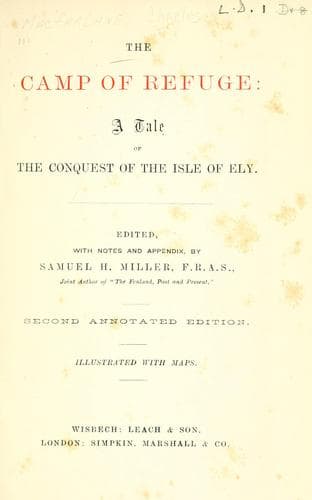
The Camp of Refuge: A Tale of the Conquest of the Isle of ElyMacFarlane, Charles
History
The Camp of Refuge: A Tale of the Conquest of the Isle of Ely
MacFarlane, Charles
Great Britain -- History -- Medieval period, 1066-1485 -- Fiction
On the day next after that on which the evil-minded prior of Ely had
formally accused Girolamo of witchcraft, and had spoken so daringly
against the Lord Abbat, Hereward marched from the Camp of Refuge with
only a few men, his intention being to increase his strength on his
march; and well did he know that at the sounding of his horn, and at
the sight of his banner, the hardy fenners would follow him
whithersoever he might choose to lead. The gleemen and menestrels who
sang the songs which had been made in honour of him were the best and
surest recruiters for the army of the Lord of Brunn. They were ever
going from township to township, with their voices and harps, or Saxon
lyres. They were small townships these in the fenny countries, and
rustical and wild. The fashion of house-building had little changed
here since the days of the ancient Britons: the houses or huts were of
a round shape, and not unlike the form of bee-hives; they had a door in
front, and an opening at top to let out the smoke, but window to let in
the light was there none; the walls were made of wattle and dab, the
roofs of rushes and willow branches cut in the fens; but the better
sort of the houses had stone foundations and rough stone pillars and
traves for the door-way, the stone having been brought from the quarry
belonging to Peterborough Abbey, or from some other distant quarry. Yet
these poor houses were not so comfortless within as might have been
prejudged by those who only saw the outside; the hides of the cattle,
the fleeces of the sheep, and the skins of the deer, and the abounding
feathers of the fen-fowl were good materials for warm covering and warm
clothing; neither turf nor wood for firing was ever lacking in those
parts, and the brawny churls that came forth from the townships,
blowing their blast-horns, or shouting for the Lord of Brunn, or
brandishing their fen poles over their heads, did not look as if they
were scant of meat, or fasted more frequently than mother church
prescribed. At the same time Elfric and Girolamo, with their party,
began their devious, roundabout march for Brandon, being instructed to
keep as much out of sight even of the country people as was possible,
and to shun any encounter with the Normans, even though tempted by ever
so favourable an opportunity. Hereward had said to them, “Our present
business is to get corn and wine for the abbey, and not to fight. Be
cautious and true to time, and diverge not a hair’s breadth from the
plan which hath been laid down. Conjoint or combined operations fail
oftener through vanity and conceit than through any other cause. But ye
be not men of that sort; ye will get your stores down to the boats at
Brandon by daybreak to-morrow morning, or between lauds and prime, and
I shall then have made my retreat, and be upon the bank of the
river[229] between Hockwold and Brandon, and ready to give ye the hand
if it should be needful. Elfric, mind keep thy swinging hanger in its
Public-domain text, read in full here on John Shaqi.
Reviews
Reviews
No reviews yet
Be the first to share your thoughts on this work.
Elsewhere in the archive
Join the Discussion
Join the discussion
Sign in to leave a comment or review.
Sign InorCreate an account