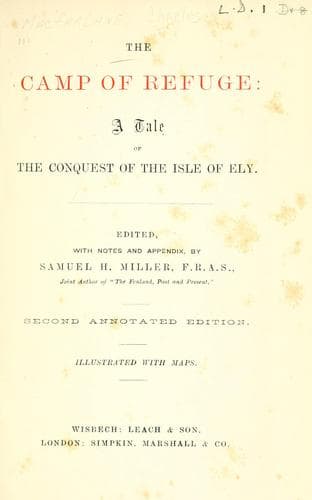
The Camp of Refuge: A Tale of the Conquest of the Isle of ElyMacFarlane, Charles
History
The Camp of Refuge: A Tale of the Conquest of the Isle of Ely
MacFarlane, Charles
Great Britain -- History -- Medieval period, 1066-1485 -- Fiction
Now it was in thinking upon this legend that Elfric, the sword-bearer
of the Lord of Brunn, was brought to turn his thoughts upon the now
well-peopled town and well-cultivated fields of the upland of Dereham;
and thus thinking, and knowing the store of wine and corn that might be
had in that vicinage, he had proposed to his lord to make a foray in
that direction, and to proceed, in part, after the manner in which the
Lord Abbat of the olden time had proceeded when he went to steal away
the body of the saint. And Elfric had been thanked by the Lord Hereward
for his suggestion, and had been called into council as well as
Girolamo, and had given many hints as to the best means of carrying out
the good plan of robbing the Saxons of Dereham (who had rather tamely
submitted to the Normans), in order to feed the monks of Ely and the
Saxons of the Camp of Refuge.
Because of the many waters and the streams that cut up the country into
the form and appearance of some great _echec_[228] board, Duke William
had not been able to make his line of beleaguerment quite so perfect
and strong on this side of the Fen-country as he had done on the other
sides; but he had posted a good number of archers and spearmen on the
uplands beyond the fens, and between Swaffham and Dereham, and upon
these he relied for checking the incursions of the Saxons, and keeping
them out of countries abounding with supplies. Now Lord Hereward had
caused to be collected a good number of skerries and other light and
fast boats, even as the good abbat had done aforetime, and these boats
had been sent up the river by night to the vicinage of Brandon, where,
with the brave fellows on board of them, they lay concealed among the
tall rushes. And while the Lord of Brunn, crossing the rivers and
meres, collected a good force in front of Swaffham, which would not
fail of drawing all the Norman troops towards that one point, his
sword-bearer and the Salernitan were to make rapidly for Brandon with
more men, and from Brandon to make for Dereham; so timing their
movements, in small parties and along different paths, that they should
all meet in the churchyard and by Saint Withburga’s well at midnight of
a moonless night, when the town would be buried in sleep.
Public-domain text, read in full here on John Shaqi.
Reviews
Reviews
No reviews yet
Be the first to share your thoughts on this work.
Elsewhere in the archive
Join the Discussion
Join the discussion
Sign in to leave a comment or review.
Sign InorCreate an account