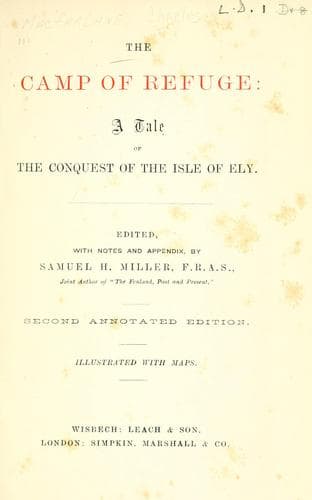
The Camp of Refuge: A Tale of the Conquest of the Isle of ElyMacFarlane, Charles
History
The Camp of Refuge: A Tale of the Conquest of the Isle of Ely
MacFarlane, Charles
Great Britain -- History -- Medieval period, 1066-1485 -- Fiction
“We tell thee again, oh Thurstan! that Harold lies buried in Waltham
Abbey, and that there be those who have seen...”
“Brother,” quoth the prior to the chamberlain, “brother, we but lose
our time in this idle and angry talk with a man who was ever too prone
to wrath, and too headstrong. The moments of time are precious! Let us
put the question.”
“Do it thyself, oh prior,” said the chamberlain, who then sat down,
looking very pale.
“It is a painful duty,” said the prior, “but I will do it.”
And having so said, the prior stood up, right before the Lord Abbat,
though not without fear and trembling, and, after stammering for some
time, he spoke in this strain, looking rather at the abbat’s feet than
in his face:—“Thurstan, it is better that one man should suffer a
temporary evil than that many men should perish! It is better that thou
shouldest cease to rule over this house than that the house, and all of
us in it, should be destroyed! I, the prior, and next in authority unto
thee, and with the consent and advice of all the chief obedientiarii of
the convent, do invite and intreat thee voluntarily to suspend thyself
from all the duties of thine office!”
“Chick of the fens, art so bold as this?” cried Thurstan, “hast thrown
thy respect for the canons of the church and the rules of this order of
St. Benedict into the same hell-pit where thou hast thrown the rest of
thy conscience? Children! brothers! ye, the ancient members of the
convent, what say ye this?”
Three monks who had grown grey in the house, without ever acquiring, or
wishing to acquire, any of the posts of eminence, to wit, Father
Kynric, Father Elsin, and Father Celred, raised their voices and said,
that such things had not been heard of before; that the prior,
unmindful of his vows, and of the deep debt of gratitude he owed unto
the Lord Abbat, was seeking to thrust him from his seat, that he might
sit upon it himself; and that if such things were allowed there would
be an end to the glory of the house of Ely, an end to all subordination
and obedience, an end to the rule under which the house had flourished
ever since the days of King Edgar, _Rex piissimus_.
Thus spoke the three ancient men; but no other monks supported them,
albeit a few of the younger members of the convent whispered in each
other’s ears that the prior was dealing too harsh a measure to the
bountiful Lord Thurstan.
Public-domain text, read in full here on John Shaqi.
Reviews
Reviews
No reviews yet
Be the first to share your thoughts on this work.
Elsewhere in the archive
Join the Discussion
Join the discussion
Sign in to leave a comment or review.
Sign InorCreate an account