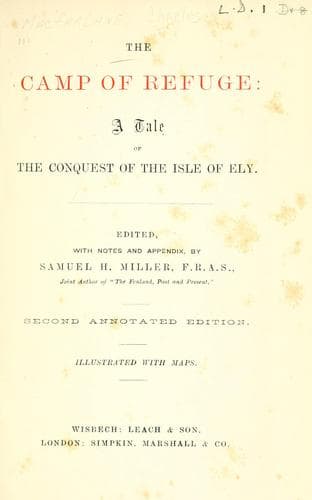
The Camp of Refuge: A Tale of the Conquest of the Isle of ElyMacFarlane, Charles
History
The Camp of Refuge: A Tale of the Conquest of the Isle of Ely
MacFarlane, Charles
Great Britain -- History -- Medieval period, 1066-1485 -- Fiction
The prior, glad to address anybody rather than the Lord Abbat, turned
round and spoke to Kynric, Elsin, and Celred: “Brothers,” said he, “ye
are mistaken as to my meaning. I, the humblest born of this good
community, wish not for higher promotion, and feel that I am all
unworthy of that which I hold. I propose not a forcible deprivation,
nor so much as a forcible suspension. I, in mine own name, and in the
names of the sub-prior, the cellarer, the sacrist, the sub-sacrist, the
chamberlain, the sub-chamberlain, the refectorarius, the precentor, and
others the obedientiarii, or officials of this goodly and godly house
of Ely, do only propound that Thurstan, our Lord Abbat, do, for a
season and until these troubles be past, quietly and of his own free
will, cease to exercise the functions of his office. Now, such a thing
as this hath been heard of aforetime. Have we not a recent instance and
precedent of it in our own house, in the case and conduct of Abbat
Wilfric, the immediate predecessor of my Lord Thurstan? But let me tell
that short tale, and let him whom it most concerneth take it for a
warning and example.—The Lord Abbat Wilfric was a high-born man, as
high-born as my Lord Thurstan himself, for there was royal Danish and
Saxon blood in his veins. Many were the hides of land, and many the
gifts he gave to this community and church: my Lord Thurstan hath not
given more! Many were the years that he lived in credit and reputation,
and governed the abbey with an unblemished character. Our refectory was
never better supplied than in the days of Abbat Wilfric; and, albeit
there were wars and troubles, and rumours of many wars in his days, our
cellars were never empty, nor was the house ever obliged to eat roast
and baked meats without any wheaten bread. It was a happy time for him
and for us! But, in an evil hour, Guthmund, the brother of my Lord
Abbat Wilfric, came unto this house with a greedy hand and a woeful
story about mundane loves and betrothals—a story unmeet for monastic
ears to hear. Guthmund, had paid his court to the daughter of one of
the greatest noblemen of East Anglia, and had gained her love. Now
Guthmund, though of so noble a family, and related to princes, was not
entitled to the privileges of prime nobility, neither took he rank with
them, forasmuch as that he had not in actual possession a sufficient
estate, to wit, forty hides of land. This being the case, the father of
the maiden forbade the troth-plight, and bade Guthmund fly his hawks in
another direction, and come no more to the house. So Guthmund came with
his piteous tale to his brother the Abbat Wilfric, who, thinking of
temporalities when he ought to have been thinking of spiritualities,
and preferring the good of a brother to the good of this house, did,
without consulting with any of the convent, but in the utmost privacy,
convey unto the said Guthmund sundry estates and parcels of land
appurtenant to this monastery, to wit, Acholt, part of Mereham,[234]
Public-domain text, read in full here on John Shaqi.
Reviews
Reviews
No reviews yet
Be the first to share your thoughts on this work.
Elsewhere in the archive
Join the Discussion
Join the discussion
Sign in to leave a comment or review.
Sign InorCreate an account