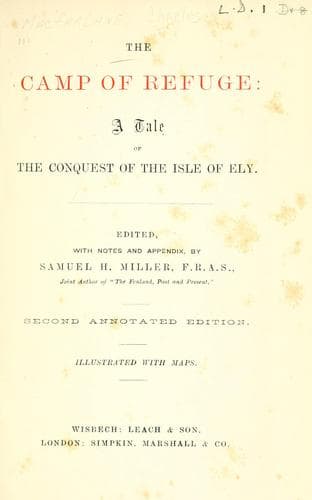
The Camp of Refuge: A Tale of the Conquest of the Isle of ElyMacFarlane, Charles
History
The Camp of Refuge: A Tale of the Conquest of the Isle of Ely
MacFarlane, Charles
Great Britain -- History -- Medieval period, 1066-1485 -- Fiction
Livermere, Nachentune, Bedenestede, and Gerboldesham, to the end that,
being possessed of them, Guthmund might hold rank with the prime
nobility and renew his love-suit with a certainty of success.[235] Wot
ye well this pernicious brother of the abbat went away not with the sad
face he had brought to the abbey, but with a very joyous countenance,
for he took with him from our cartularies, the title-deeds of those
broad lands which had been given to the abbey by sundry pious lords.
Yes! Guthmund went his way, and was soon happy with his bride and the
miserable pleasures of the flesh, and the pomps and vanities of the
world. But the abbat, his brother, was never happy again, for his
conscience reproached him, and the secret of the foul thing which he
had done was soon discovered. The brotherhood assembled in chapter,
even as it is now assembled, denounced the robbery, the spoliation, and
sacrilege, and asked whether it were fit that such an abbat should
continue to hold rule over the house? Wilfric, not hardened in sin, but
full of remorse, felt that he could no longer be, or act as Lord Abbat,
and therefore went he away voluntarily from the abbey, renouncing all
authority. Yea, he went his way unto Acholt, where, from much sorrow
and perturbation of mind, he soon fell sick and died: and, as he died
very penitent, we brought back his body for sepulture in the abbey
church; and then proposed that our brother Thurstan should be our Abbat
and ruler.”
“Saint Etheldreda give me patience!” said Thurstan, “Oh prior, what
have I to do with this tale? Why revive the memory of the sins of a
brother, and once superior and father, who died of grief for that which
he had done, and which an excess of brotherly love had urged him to do?
How doth this tale apply to me? what have I had to do in it or with it,
save only to recover for this house the lands which my unhappy
predecessor conveyed away? I have brought ye hides of land, but have
given none to any of my kindred. That which hath been spent since the
black day of Hastings, hath been spent for the defence of the patrimony
of Saint Etheldreda, and for the service of the country. Have I not
brought Guthmund to compound with me, and to agree to hold from, and
under the abbey, and during his lifetime only, and with payment of dues
and services to the abbey, all the lands which his brother, the Abbat
Wilfric,—may his soul find pardon and rest!—alienated by that wicked
conveyance? and hath not the same Guthmund given us the dues and
services; and will not the lands of Acholt, Mereham, Livermere,
Nachentune, Bedenestede, and Gerboldesham revert to the house so soon
as he dies? Oh prior, that hast the venom of the serpent without the
serpent’s cunning, if ye bring in the son of the harlot of Falaise, and
if some pauper of a Norman knight get hold of these lands, the abbey
will never get them back again!” [And as Thurstan said, so it happened.
The demesnes were given to one Hugo de Montfort, and the church was
Public-domain text, read in full here on John Shaqi.
Reviews
Reviews
No reviews yet
Be the first to share your thoughts on this work.
Elsewhere in the archive
Join the Discussion
Join the discussion
Sign in to leave a comment or review.
Sign InorCreate an account