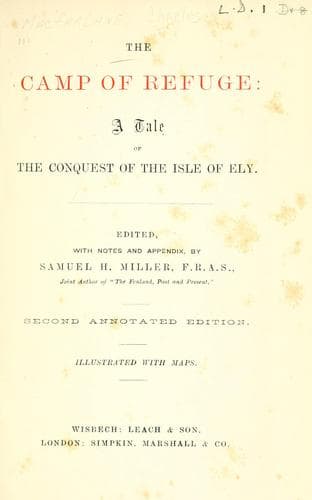
The Camp of Refuge: A Tale of the Conquest of the Isle of ElyMacFarlane, Charles
History
The Camp of Refuge: A Tale of the Conquest of the Isle of Ely
MacFarlane, Charles
Great Britain -- History -- Medieval period, 1066-1485 -- Fiction
“I thought as much as all this,” quoth the sword-bearer; and without
asking any questions, he followed the cloister-monk and the lay-brother
to the gatekeeper’s chamber, praising and blessing the saints for this
his so speedy deliverance. As he entered the room, reverentially
saluting the other cloister-monks, the porter gave him his sword, which
had been snatched from him upon his being first seized under the
gateway. Next the stout porter took down some swords and spears, and
fen-poles, that hung in his room, and armed his friends and himself
with them; and then, in less than a Credo, the whole party got out of
the monastery through the wicket-gate, and, first closing and fastening
the wicket on the outside, they all took the broad high road that leads
to Turbutsey. Six good cloister-monks, and ten good lay-brothers and
servientes, were there in this company; but all the rest of the convent
remained behind to await the slaughter of their countrymen in the Camp,
to welcome the Normans to Ely, and to get from them—that which they
deserved. Elfric and Tom of Tottington (an expert fenner, and much
fitter to be a soldier than the waiting-man of a monk) presently
quitted the road to take a rough path across the fens which led
directly into the Camp: the rest hastened on to Turbutsey, and as they
arrived there before the midnight, they were in good time to aid the
true men Elfric had left there in getting the good stores across the
river and well into the fens. Some of the party would have left the
body of Girolamo behind at Turbutsey, or would have thrown it into the
river; but the people said what Elfric had said to them concerning the
dead body, and the fighting men who had fought the Normans near
Brandon, and who had seen with their own eyes the Christian end the
Salernitan had made, all declared that Girolamo must have Christian
burial in some consecrated place where the Normans could not disturb
his ashes.
CHAPTER XXV.
THE NORMANS IN THE CAMP.
Public-domain text, read in full here on John Shaqi.
Reviews
Reviews
No reviews yet
Be the first to share your thoughts on this work.
Elsewhere in the archive
Join the Discussion
Join the discussion
Sign in to leave a comment or review.
Sign InorCreate an account