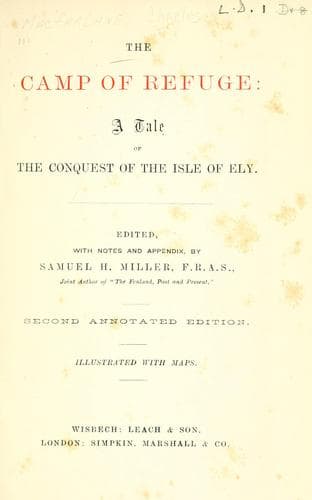
The Camp of Refuge: A Tale of the Conquest of the Isle of ElyMacFarlane, Charles
History
The Camp of Refuge: A Tale of the Conquest of the Isle of Ely
MacFarlane, Charles
Great Britain -- History -- Medieval period, 1066-1485 -- Fiction
The Camp of Refuge, wherein the Saxons had so long withstood the
violent threats of the Normans, was not in itself a very noticeable
place. But for the army and the last hopes of England collected
therein, the wayfarer might have passed it without any especial
observation, there being several such places in the Fen country, partly
surrounded by embankments of earth, and wholly girded in, and doubly or
trebly girded by rivers, ditches, pools, and meres. The embankments had
been first made, in very remote ages, by those who first attempted to
drain parts of the fen country; but tradition said that these peaceful
works had been made to serve the purposes of defensive war, in those
days when the Iceni stood against their Roman invaders, when the
Britons stood against the first Saxons, and when the Saxons opposed the
marauding Danes. The embankments which were made to keep out the water,
and confine the rivers to their beds, were proper to keep out an enemy,
even if he could reach them; and the fenners, who kept solely to the
business of grazing, fishing, and fowling, knew best how to defend and
how to stock such places. In the upland countries men took shelter on
the high hills; but here, when an enemy approached, men threw
themselves within these flats and enclosures in the midst of the
waters, taking with them their herds and flocks, and their hooks and
nets for fishing, and their snares for fowling. At the first sound of
this Norman invasion, and before any Saxon lord or knight fled for
refuge into the Isle of Ely, the people of the country drove their
fattening beeves into the enclosed but wide space which afterwards came
to be called the Camp, but which for a long season bore rather the
appearance of a grazing-field than that of a place of arms; and even
when the Saxon lords and knights came and gathered together their armed
followers on that green grassy spot, the space was so wide that the
cattle were left to remain where they were, and the many cowherds and
shepherds were mixed with the Saxon soldiery, each by times doing the
duty of the other; and now, when well-nigh everything else was consumed
and gone, there remained within the broad limits of the Camp great
droves of the finest and fattest cattle.
There was no moon, and the night was of the darkest, when Elfric
approached the Camp, flying along the ground like a lapwing. As watches
were set, and as the men were vigilant as became the soldiers of the
Lord of Brunn, he was challenged sundry times before he reached his
lord’s tent. Hereward was asleep, but at the voice and tidings of his
sword-bearer he was presently up and armed, and ready to go the round
of the Camp.
Public-domain text, read in full here on John Shaqi.
Reviews
Reviews
No reviews yet
Be the first to share your thoughts on this work.
Elsewhere in the archive
Join the Discussion
Join the discussion
Sign in to leave a comment or review.
Sign InorCreate an account