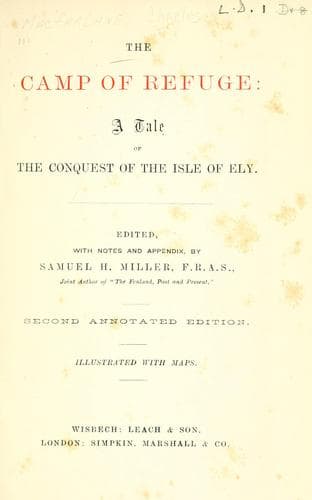
The Camp of Refuge: A Tale of the Conquest of the Isle of ElyMacFarlane, Charles
History
The Camp of Refuge: A Tale of the Conquest of the Isle of Ely
MacFarlane, Charles
Great Britain -- History -- Medieval period, 1066-1485 -- Fiction
The Normans began to enter the Camp in overpowering numbers; and
although the first glimmerings of day began to be seen from the east,
it was still so dark that it was hard to distinguish between friend and
foe. But Hereward soon found himself at the spot where the danger was
greatest; and the foe, who had not yet recovered from the dread of his
name, halted at the shouts of “Hereward for England!” and were soon
driven out of the Camp, with a great slaughter. Whilst this was doing
on the south-western side, another host of Normans, under the same
traitorous guidance, got round towards the north face of the Camp, and
after some hard fighting, got over the embankment, and into the Camp.
Leaving a brave old Saxon earl and his people to keep the ground he had
recovered, Hereward rushed with Elfric and his own choice band to the
northern side; and although the distance was considerable, his
battle-axe was ringing among the Normans there before they had found
time to form themselves in good fighting order. But Odo, the fighting
bishop, was among these Normans; and thus knights and men-at-arms
fought most valiantly, and held the ground they had gained for a long
time. Nevertheless, just as the rising sun was shining on the tower of
Ely Abbey, Odo and his host, or such of his host as survived, retreated
the way they had come; but while they were in the act of retreating,
Duke William led in person an assault on another part of the Camp; and
on the south-west side, the brave old Saxon earl being slain, his men
gave way, and the Normans again rushed in on that side. Also, and at
nearly the same instant of time, Norman spears were discerned coming
round upon the Camp from other quarters. As he paused to deliberate
whither he should first direct his steps, and as he shook the blood
from the blade and shaft of his battle-axe—a ponderous weapon which no
other man then in England could wield—the Lord of Brunn, still looking
serenely, bespoke his sword-bearer, “May God defend the house of Ely
and the Lord Abbat; but the knavish monks have done the work of
treachery very completely! They must have made known unto the Normans
all the perilous passages of the fens. We are beset all about! But we
must even drive the Normans back again. Numerous are they, yet their
knights love not to fight on foot, and they can have brought few horses
or none across the swamps. But Elfric, my man, thou art bleeding! Art
much hurt?”
Now, although Elfric had got an ugly cut upon his brow, he smiled, and
said, “’Tis nothing, good my Lord: ’tis only a scratch from the sharp
end of Bishop Odo’s pastoral crook. If he had not been so timeously
succoured, I would have cleft his shaven crown in spite of his steel
cap, or have made him a prisoner!”
Public-domain text, read in full here on John Shaqi.
Reviews
Reviews
No reviews yet
Be the first to share your thoughts on this work.
Elsewhere in the archive
Join the Discussion
Join the discussion
Sign in to leave a comment or review.
Sign InorCreate an account