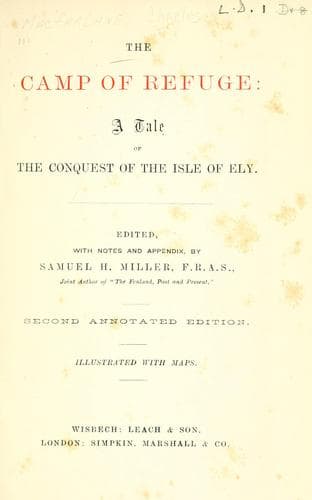
The Camp of Refuge: A Tale of the Conquest of the Isle of ElyMacFarlane, Charles
History
The Camp of Refuge: A Tale of the Conquest of the Isle of Ely
MacFarlane, Charles
Great Britain -- History -- Medieval period, 1066-1485 -- Fiction
“Elfric,” said Hereward, “if the traitorous monks of Ely shall have
called in their own people, who formed our outer guard, and have given
the Normans the clue to the watery labyrinth which has been our
strength and safety so long, we may still hold out against more than
one assault behind the embankments of this Camp, provided only our
people do not get panic-stricken by the suddenness of the attack, and
in the darkness of this night. Would that it were morning! But come
what may, there is one comfort: we shall have our harness on our backs
before the fight begins!”
And having so said, the Lord of Brunn, followed by his sword-bearer,
went from post to post to bid the men be on the alert, and from tent to
tent, or from hut to hut, to rouse the sleeping chiefs to tell them
that the monks of Ely were traitors to the good cause, and that the
Normans were coming; and when this was done, Hereward, with an
unperturbed spirit, and with all that knowledge of war which he had
acquired beyond sea, and from the knowing Salernitan, and from all that
quickness which nature had given him, laid down his plan for defending
the interior of the Camp, and appointed every chief to the post he
should hold, speaking cheerfully to them all, and telling them that
five years had passed since the battle of Hastings, and that England
was not conquered yet; and that if the Normans should be foiled in this
attack, their loss would be terrible, their retreat across the fens
almost impracticable.
By the time all this was said and done it was more than two hours after
the midnight hour, and it had scarcely been done ere the war-cry of the
Normans was heard close under the south-western face of the Camp. By
using the name of the Abbat Thurstan, the false prior had made the
people of the abbey abandon the fords in that direction; and by the
same false prior’s procurement, a traitorous fenner had guided the
Normans through the labyrinth. But there was more fatal mischief yet to
proceed from the same dark cauldron and source of evil. Some other
traitor, serving among the retainers of the abbey that had been left
quartered in the Camp, because they could not be withdrawn without Lord
Hereward’s order set up the cry that the Saxons were all betrayed, and
that the Normans had gotten into the Camp; and thereupon the poor
bewildered wights, who knew but too well that the Norman war-cry could
be heard where it was heard only through treachery, fell into disorder
and dismay, and abandoning the post which they had been appointed to
hold, and disregarding the voice of their commander, they fled across
the Camp, shouting, “Treason! treason! Fly, Saxons, fly!”
Public-domain text, read in full here on John Shaqi.
Reviews
Reviews
No reviews yet
Be the first to share your thoughts on this work.
Elsewhere in the archive
Join the Discussion
Join the discussion
Sign in to leave a comment or review.
Sign InorCreate an account