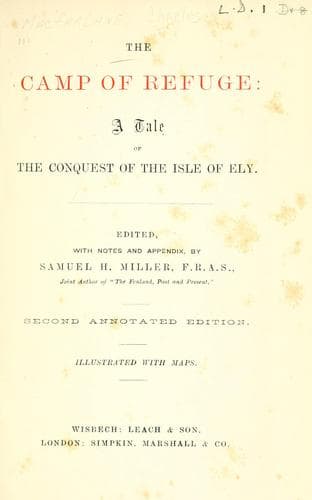
The Camp of Refuge: A Tale of the Conquest of the Isle of ElyMacFarlane, Charles
History
The Camp of Refuge: A Tale of the Conquest of the Isle of Ely
MacFarlane, Charles
Great Britain -- History -- Medieval period, 1066-1485 -- Fiction
And at these good words three hundred stout Saxons and more formed
themselves into a compact column, and the Lord of Brunn, with Elfric by
his side, put himself in the head of the column, and the band shouted
again, “Hereward for England! Saxons, remember Hastings!” Then were
heard the voices of command all along the different Norman lines, and
from the right and from the left, from behind and from before, those
lines began to move and to close, and to form living barriers and
hedgerows of lances on every side: and next, near voices were heard
offering fifty marks of gold to the man that should slay or seize the
traitor Hereward. But the Norman was not yet born that could withstand
the battle-axe of the Lord of Brunn: and so the Norman lines yielded to
his charge, and so he led his three hundred Saxons and more
triumphantly out of the Camp and across the fens—yea, over rivers and
streams and many waters, where Normans could not follow—until they
came into a thick wood of willows, where they found the six good
cloister-monks and the ten good lay-brothers who had fled with Elfric
from Ely Abbey, and the party of true men from Turbutsey, who had
carried with them the corn, meal, and wine, and likewise the body of
Girolamo of Salerno. Loudly was the Lord of Brunn greeted by every man
that was in the wood. The first thing that was done after his coming
was to bury the Salernitan. Near the edge of the wood, and by the side
of a stream, the monks of Ely of the old time had built a small
mass-house for the conveniency of the souls of some of the fenners, who
could not always quit their fishing and fowling and go so far as the
abbey church; and on a green dry hillock, at the back of the
mass-house, there was a small cœmeterium holding the wattled graves of
not a few of the fenners.
“This ground,” said Father Celred, “is consecrated ground; the Normans
will not soon get hither, and we will leave no cross and make no sign
to show the stranger’s grave; and every man here is too true a man ever
to betray the secret to the Normans.”
“And when better days come, we will provide some suitable monument for
the stranger who died in fighting for the Saxon. Girolamo, thou art
happy in that thou hast not lived to see this foul morning! Father
Celred, fathers all, I warrant ye he was a true son of the church, and
died a good Christian. So withhold not to do the rites and give him
Christian burial.”
Public-domain text, read in full here on John Shaqi.
Reviews
Reviews
No reviews yet
Be the first to share your thoughts on this work.
Elsewhere in the archive
Join the Discussion
Join the discussion
Sign in to leave a comment or review.
Sign InorCreate an account