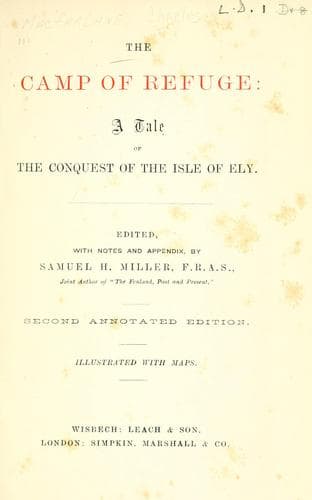
The Camp of Refuge: A Tale of the Conquest of the Isle of ElyMacFarlane, Charles
History
The Camp of Refuge: A Tale of the Conquest of the Isle of Ely
MacFarlane, Charles
Great Britain -- History -- Medieval period, 1066-1485 -- Fiction
Thus spake the Lord of Brunn as he gazed upon the awfully placid face
of the Salernitan, whose body lay uncovered upon a rustic bier: and the
good monks all said that they doubted not, and would never doubt, the
word of Lord Hereward. And the Saxon hinds, under the direction of
Elfric, rapidly scooped out a grave on the sunniest side of the green
hillock, on the side which faced the south and was turned toward the
sunny land in which the stranger was born; and when the grave was made,
Hereward took his own good mantle from his shoulders and piously
wrapped it round the dead body to serve it instead of shroud and
coffin, which could not be had; and then Father Celred blessed the
grave, and the lay-brothers laid the body reverentially in it; and then
all the monks that had come from Ely said the service for the dead and
chanted the _De Profundis_. Next the earth was thrown in, and the green
sods, which had been removed carefully and piecemeal, were laid upon
the surface and joined together so as to unite and grow together in a
few days, making the spot look like the rest of the sward: and thus,
without mound or withy-bound hillock, without a stone or a cross, was
left all that could die of Girolamo the Salernitan—far, far, far away
from the land of his birth and of his love. Yet was his lowly grave not
unhonoured.
After these sad offices, Hereward and his party refreshed themselves
with wine and bread, and renewed their march, going in the direction of
the river Welland and the succursal cell at Spalding.[242]
Public-domain text, read in full here on John Shaqi.
Reviews
Reviews
No reviews yet
Be the first to share your thoughts on this work.
Elsewhere in the archive
Join the Discussion
Join the discussion
Sign in to leave a comment or review.
Sign InorCreate an account