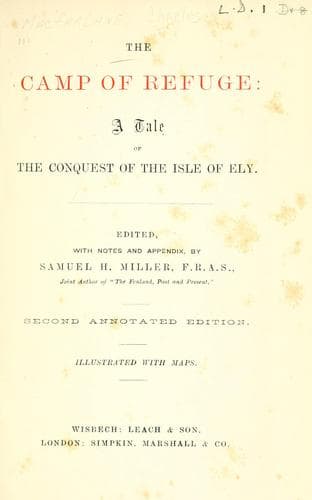
The Camp of Refuge: A Tale of the Conquest of the Isle of ElyMacFarlane, Charles
History
The Camp of Refuge: A Tale of the Conquest of the Isle of Ely
MacFarlane, Charles
Great Britain -- History -- Medieval period, 1066-1485 -- Fiction
And how fared it with the guilty prior and the traitorous monks of Ely?
Did they profit by their great treason? Were peace and joy their lot
when the blood of their countrymen had been poured out like water? Did
they and their house thrive after all that torture and horror in the
Camp? Not so! not so! Those who deal in treachery reap treachery for
their reward; and all men hate and scorn even the traitors who have
most served them. Before the butchery in the Camp was well over, a
great band of Normans ran to the abbey and took forcible possession of
it, and beat and reviled the monks because they did not bring forth the
money and the bread and wine which they had not to give; and these rude
soldiers lodged themselves in the house, and turned all the monks into
the barns and outhouses—all but a few, who remonstrated and resisted,
and who where therefore thrown into that noxious prison underground
into which they had cast Elfric the night before. And on the morrow of
the fight in the Camp, the Norman Duke[243] himself went up to the
abbey with all his great chiefs, saying that he would pay his devotions
at the shrine of St. Etheldreda, albeit she was but a Saxon saint. And
William did go into the church, and kneel at the shrine of the saint.
Yea, he did more than this, for he laid his offering upon the shrine.
But what was the princely offering of this great prince who ruled on
both sides of the sea?—It was just one single mark of gold,[244] and
that a mark which had been in the hands of the Jews and clipped! And
when he had made this splendid donation, he called the monks together
in the hall, and told them that they must pay unto him a thousand marks
of gold as the price of his pardon for the long rebellion they had been
in. And when the chapfallen chamberlain said, and said truly, that
there was no money in the house, a sneering Norman knight told him that
there were Jews at Norwich, and that the monks must get money by
pledging their lands and by giving bonds to the Israelites. The good
Abbat Thurstan, being still sick in his bed, escaped the sight of much
of this woe: but when the prior knelt at the foot of Duke William, and
said that he trusted he would be merciful to the ruined house, and
continue him as the head of it, and sanction his election by the
brotherhood as lord abbat, the Duke swore his great oath, “By the
splendour of God’s face,” that he was not so minded; and that Abbat
Thurstan should be abbat still, inasmuch as he was a man of noble birth
and of a noble heart. Sundry great Saxon lords, who had long since made
their peace with the Norman, had spoken well for the high-born
Thurstan; but that which decided the mind of Duke William was the
reflection that, if so true and stout a man as Thurstan promised him
his allegiance, he would prove true to his promise at whatsoever
crisis; while no faith or trust could be put in the promises and vows
of such a man as the prior. And thus Thurstan[245] was told on his
Public-domain text, read in full here on John Shaqi.
Reviews
Reviews
No reviews yet
Be the first to share your thoughts on this work.
Elsewhere in the archive
Join the Discussion
Join the discussion
Sign in to leave a comment or review.
Sign InorCreate an account