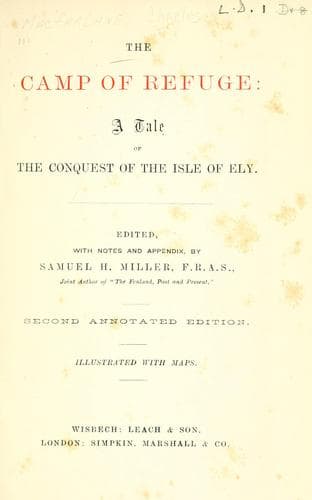
The Camp of Refuge: A Tale of the Conquest of the Isle of ElyMacFarlane, Charles
History
The Camp of Refuge: A Tale of the Conquest of the Isle of Ely
MacFarlane, Charles
Great Britain -- History -- Medieval period, 1066-1485 -- Fiction
sick-bed that his rule was restored, and that he should be allowed to
appoint and have a new set of officials, instead of the prior, the
chamberlain, the sacrist and sub-sacrist the cellarer, and all the rest
that had been rebellious and traitorous unto him—provided only that he
would promise to be at peace with the Normans. And, after Thurstan had
been most solemnly assured by some of the Saxon thanes who came to the
abbey with the Conqueror, that King Harold, his benefactor, was
assuredly dead, and lay buried in Waltham Abbey, and that good terms
would be granted to his friend my Lord of Brunn if he would but cease
the hopeless contest, Thurstan promised to live in peace and to think
no more of resistance: and before Duke William departed from the house
of Ely the lord abbat saluted him as King of England, and put his hand
into his hand as a token and pledge that he was and would be true and
liege man unto him. It cost his Saxon heart a pang which almost made it
crack; but having thus pledged himself, nothing upon earth, being
earthly, would ever make Thurstan untrue to the Norman.
In leaving the abbey, the Conqueror did not remove with him all the
Normans. On the contrary, he called up still more knights and
men-at-arms, and ordered them all to quarter themselves upon the
monks, and be by them entertained with meat, drink, and pay, as well
as lodging.[246] The Norman knights and soldiers kept possession of
the best parts of the house, respecting only the inner apartments of
the restored abbat: the knights suspended their arms and shields in
the great hall, where the arms of the Saxon thanes had lately hung,
and in the refectory at every meal-time a hungry Norman soldier was
seated by the side of every monk. This was a strange and unseemly
sight to see in the common hall of so noble and once so religious a
house; but it was the will of the Conqueror that it should be so, and
the monks had brought down all these mischiefs upon their own heads.
From the lands and revenues especially appertaining to Thurstan as
lord abbat, the Norman knights were not allowed to take much; but upon
those appertaining to the monks in common, they fell without
restriction and without remorse, seizing a manor here and a manor
there, and getting them converted into heritable property, to their
heirs for ever, by grant and fief-charter from Duke William. And while
so many broad hides were taken from them for good, the monks were
compelled to pledge other lands, and the very revenues of the shrines,
in order to pay the imposed fine of a thousand marks, and in order to
find meat and drink, and whatsoever else was demanded by their
rapacious guests. Sad grew the monks of Ely, and every day thinner.
The knights and men-at-arms ever helped themselves first, and very
often left their unwilling hosts nothing to eat. The proverb about the
glorious feast of the monks of Ely seemed to have become nothing but a
proverb, or the mere legend of a state of happiness which had passed
Public-domain text, read in full here on John Shaqi.
Reviews
Reviews
No reviews yet
Be the first to share your thoughts on this work.
Elsewhere in the archive
Join the Discussion
Join the discussion
Sign in to leave a comment or review.
Sign InorCreate an account