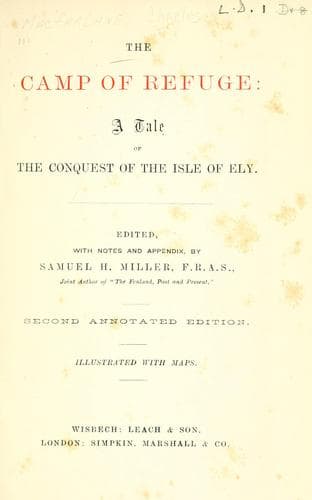
The Camp of Refuge: A Tale of the Conquest of the Isle of ElyMacFarlane, Charles
History
The Camp of Refuge: A Tale of the Conquest of the Isle of Ely
MacFarlane, Charles
Great Britain -- History -- Medieval period, 1066-1485 -- Fiction
Away went the Saxons among the willows and tall rushes, until they came
close to the causey which led from the bank of the river to the moated
manor-house, and which was hard and dry now, although in the winter
season it was for the most part under water. The Normans, who were
making an exceeding great noise themselves, heard not the little
unavoidable noise made by Lord Hereward’s people; and notwithstanding
the light thrown up by the burning town, the Frenchmen saw not more of
the Saxons than they heard of them, until they set up their shouts of
“Hereward for England! The Saxons to the rescue!” And scarcely had the
first of these shouts ceased to be echoed ere Hereward and his true men
were upon the causey and hewing down the astounded enemy, of whom not a
few were without their arms, for they had been bringing across the
river great beams and planks wherewith to cross the moat of the
manor-house. The Normans that were still on the opposite side of the
river, beleaguering the succursal cell, came down to their boats and
attempted to cross over to succour their countrymen on the causey; but
Lord Hereward posted fifty good archers among the willows at the very
edge of the water, and, taking good aim in the red fire-light, these
good bowmen sent such fatal flights of arrows into the boats that the
Normans put back in dismay: and the boats which had been going up and
down the river, full of armed men, took all to flight upon hearing the
shouts of “Hereward for England,” and never stopped until they got out
of the Welland into the broad Wash, where the Conqueror, by the advice
of the false Danes, had collected a fleet of ships. At these good signs
some of the town folk of Spalding, who had fled into the fens to escape
the Norman fury, returned towards their burning town and threatened the
rear of their foe; and some other of the town folk, who had thrown
themselves into the Cell to assist the true monks who had driven out
the false ones, now joined in shouting “Hereward for England;” and
getting to the house-top, assailed their beleaguerers with arrows and
javelins, and whatsoever else they could get to hurl at them. Thus
stood the Norman host, part on one side of the river and part on the
other, and no communication between them. Yet when those on the causey
were joined by a great band that had been up to the manor-house, they
were far more numerous than the Saxon party. With the band that came
down from the manor-house was Ivo Taille-Bois himself; and his people
shouted as he came upon the ground where battle had been joined, “A
Taille-Bois! a Taille-Bois!”
Public-domain text, read in full here on John Shaqi.
Reviews
Reviews
No reviews yet
Be the first to share your thoughts on this work.
Elsewhere in the archive
Join the Discussion
Join the discussion
Sign in to leave a comment or review.
Sign InorCreate an account