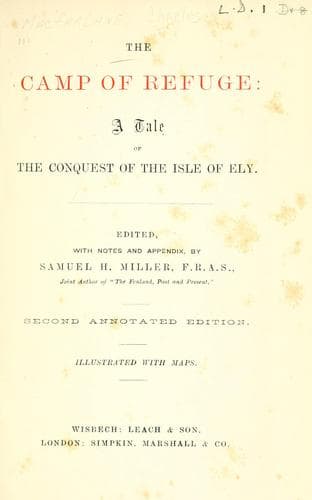
The Camp of Refuge: A Tale of the Conquest of the Isle of ElyMacFarlane, Charles
History
The Camp of Refuge: A Tale of the Conquest of the Isle of Ely
MacFarlane, Charles
Great Britain -- History -- Medieval period, 1066-1485 -- Fiction
The Lord of Brunn, who had made a good free space with his own single
battle-axe, now cried out in his loudest and cheeriest voice, “Welcome,
oh Ivo Taille-Bois! I as good as told thee on my wedding-day at Ey that
we should meet again! Ivo, all that I ask of thee now is that thou wilt
not turn from me! Ivo Taille-Bois, this is a fair field! Here is good
hard ground, and no fen-pool; so, Sir Ivo, stand forward, and let thee
and me prove which is the better man and the better knight!”
But Ivo, remembering still the battle of Hastings and the weight of
Lord Hereward’s battle-axe—albeit it was but a stripling’s arm then
wielded it—would not stand forward; and he only cried from among his
men-at-arms and the knights that were with him, “This is no fair field,
and I have no horse, and a knight should engage in single combat only
on horseback; and thou art no true knight, but only a priest-made
knight, and a rebel and traitor!”
“For the last thou liest in thy throat,” quoth the Lord of Brunn. “I am
a free and true Saxon fighting for his country against invaders and
robbers! Thou art but a beast to make thy valour depend upon a
four-legged creature! But since thou wilt not stand forth and try thy
strength and skill with me here in this good space between our two
hosts, I will come and seek thee in the midst of thy people. So, Ivo,
look to thyself!”
And having thus spoken, the Lord of Brunn waved his battle-axe over his
head and sprang forward, and Elfric went close by his side, and the
boldest of his Saxons followed him, shouting again “Hereward for
England! Saxons to the rescue of the Ladie Alftrude!” And so loud were
these shouts that they were heard afar off on either side of the river,
and were given back not only by the true men in the succursal cell and
by the returning townsfolk of Spalding, but also by the stanch little
garrison which had been left with the Ladie Alftrude in the moated
manor-house. The torches which the Normans had been carrying were all
extinguished and thrown away, and moon or star was none, but the ruddy
flames from the burning town still gave light enough for the good
aiming of sword, pike, and battle-axe. For a time the Normans stood
their ground on the causey, and did manfully enough; but when Ivo
Taille-Bois saw the carnage the Lord of Brunn was making, and saw that
his battle-axe was opening a path through his dense phalanx to the spot
where he stood, he bade his trumpet sound a retreat. Ivo could not have
done a worse thing, for so soon as his men began to retreat they got
into a panic; and while some ran along the causey, others quitted that
road and ran into the fens. Nay, Ivo himself was swept from the road,
and compelled to run for it across a broad marsh where there was at
this season little water, but much mud. Lord Hereward, who saw him go,
said to his sword-bearer, “That big bully of Angevin is not worth my
following: go, Elfric, and bring him hither; you will find him
somewhere there among the bulrushes.
Public-domain text, read in full here on John Shaqi.
Reviews
Reviews
No reviews yet
Be the first to share your thoughts on this work.
Elsewhere in the archive
Join the Discussion
Join the discussion
Sign in to leave a comment or review.
Sign InorCreate an account