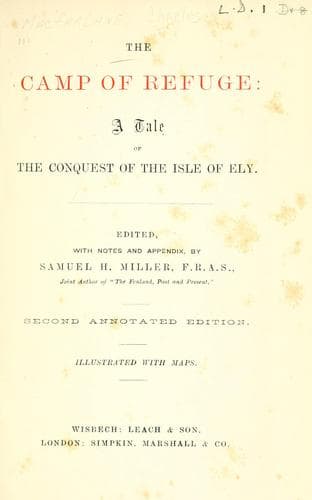
The Camp of Refuge: A Tale of the Conquest of the Isle of ElyMacFarlane, Charles
History
The Camp of Refuge: A Tale of the Conquest of the Isle of Ely
MacFarlane, Charles
Great Britain -- History -- Medieval period, 1066-1485 -- Fiction
It was not an hour since Hereward first fell upon the Normans on the
causey, and everything that he could do for this night was already
done. He bade Elfric count the prisoners and the number of the slain.
Without counting those who had perished in the fens, more than two
score Normans lay stark dead on the causey. More were wounded, but not
half a score of Saxons were slain. The exceeding great light which had
come from the burning town was now dying away, for the flames had
consumed everything that was consumable in Spalding. But many torches
were soon lighted, and by their light the Lord of Brunn and his
faithful sword-bearer marched hastily towards the manor-house, over
which their hearts had long been hovering; and they were followed
thitherward by Ivo Taille-Bois and the rest of the prisoners, and by a
part of the Saxon force, the rest of those three hundred true men being
left to guard the river and the succursal cell.
At the sound of his horn the drawbridge was lowered and the gates of
the manor-house were thrown open to the Lord of Brunn; and then was
there happy meeting in the hall with the Ladie Alftrude and the maid
Mildred—so happy that Hereward and Elfric forgot for the time the
shame and woe of that bloody morning, and the young dame and the maiden
forgot their own late agony and danger: nor was it when the lady
brought her first-born son, rosy from his sleep, and put him in the
arms of his glad sire, and when maid Mildred hung upon the arm of the
sword-bearer and called him her deliverer, and said that she would
never more leave him, but go whithersoever he might go, that these sad
things could be brought back to the mind, or that either Hereward or
Elfric could recollect that henceforward they and those who were
dearest unto them must lead a wandering life in the wilds and the fens.
Nay, when a cheerful fire was lit in the great hall, and the tables
were well spread, and the drinking-horns well filled, every good Saxon
present seemed to think that this joy must last.
Yet if, in the morning after this happy meeting, there came sad
thoughts and many and much sadder recollections, there was no craven
panic, nor so much as any visible perturbation or confusion. _Vir
serenissimus_, a most serene and imperturbable man, was the Lord of
Brunn: and to this high quality of his nature was mainly owing all that
he had done and all that he lived to do afterwards. The Ladie Alftrude
was worthy to mate with such a lord; and their serenity made serene and
confident all those that were about them. And therefore was it that
when the foul treason at Ely was made known to all of them, and when
much more bad news was brought in, as that the Normans had stormed and
taken the lady’s manor-house at Ey and the lord’s manor-house at Brunn,
and had been admitted again into Crowland Abbey, these good Saxons lost
not heart and abated not of hope, but vowed that they would fight to
the last for Lord Hereward, and be true to him in every extremity.
Public-domain text, read in full here on John Shaqi.
Reviews
Reviews
No reviews yet
Be the first to share your thoughts on this work.
Elsewhere in the archive
Join the Discussion
Join the discussion
Sign in to leave a comment or review.
Sign InorCreate an account