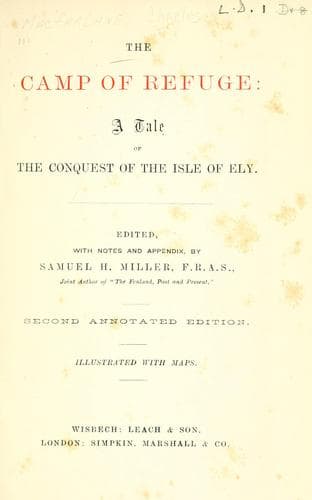
The Camp of Refuge: A Tale of the Conquest of the Isle of ElyMacFarlane, Charles
History
The Camp of Refuge: A Tale of the Conquest of the Isle of Ely
MacFarlane, Charles
Great Britain -- History -- Medieval period, 1066-1485 -- Fiction
All things were got ready for a retreat into the farthest parts of
Lincolnshire, or into the impenetrable country upon the Wash, as
expediency might dictate; for it was thought that the Normans, being so
near, would not delay in bringing a great army against Spalding
manor-house, and in making the most desperate efforts to seize the last
great Saxon lord that was now in arms against them. But the autumn
season was now at hand, and it was so ordained that the heavy rains set
in earlier than usual, and fell more heavily and lasted longer than
common, in such sort that the fens were laid under water and the roads
made impassable. And although many boats of all sorts and sizes were
collected, they could not be used, for a fresh gathering on the
Scottish border[252] constrained Duke William to turn his attention
thitherward and to dispatch to the river Tyne and to the river Tweed
many of the warriors and shipmen that had been collected to complete
the subjugation of the fen country. When these Normans were gone, Lord
Hereward drove their monks once more from Crowland Abbey, and got
possession of his house at Brunn and of the stores which had been there
deposited; and after making many good forays into the upland country,
he brought his brave fenners back to Spalding, together with a good
number of Norman prisoners, of whom some were of high degree. The poor
unhoused townfolk of Spalding found shelter for the winter in the large
manor-house and in the succursal cell, or in Crowland Abbey, keeping
themselves ready to move in the spring with the Lord of Brunn and his
warlike band. There was abundance of wine and corn, and meat and fish,
and all good things in this new Camp of Refuge; and the winter passed
merrily away, with all due observation made of saints’ days and of all
the feast days the Saxon church had appointed. But one feast there was
which was more joyous than all the rest; and that was given by the Lord
of Brunn, ever free of hand and large of soul, a short time before the
quinzaine of the Nativity, when Elfric and Mildred were made man and
wife. Their hands were joined by the same Alefricus Diaconus who had
been Lord Hereward’s mass-priest at Brunn, and who had performed the
marriage-rites for his lord and the Ladie Alftrude at Ey. But the
true-hearted monks of Spalding, and the monks that had fled from Ely,
took part in the ceremony in the chapel, as afterwards in the feast in
the hall; for notwithstanding all the mischief that the monks of Ely
had done him, Hereward was still _homo monachorum_, or a lover of
monks—provided only they were true Saxon monks, and had no dealings
with the Normans. But all true Saxons and bold fenners for many miles
round feasted at Spalding on Elfric’s wedding day; the freed-men being
entertained according to their degree, and the churls and serfs
according to their degrees. Alefric, the deacon, put these things into
a book, but the pages[253] are now missing.
CHAPTER XXVII.
Public-domain text, read in full here on John Shaqi.
Reviews
Reviews
No reviews yet
Be the first to share your thoughts on this work.
Elsewhere in the archive
Join the Discussion
Join the discussion
Sign in to leave a comment or review.
Sign InorCreate an account