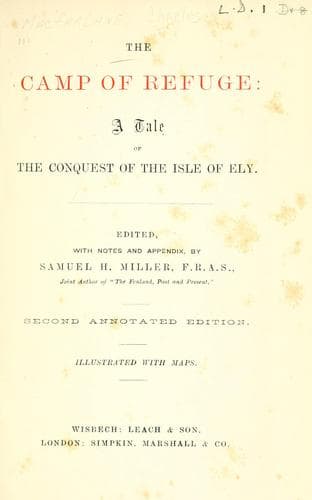
The Camp of Refuge: A Tale of the Conquest of the Isle of ElyMacFarlane, Charles
History
The Camp of Refuge: A Tale of the Conquest of the Isle of Ely
MacFarlane, Charles
Great Britain -- History -- Medieval period, 1066-1485 -- Fiction
Brunn declared that he wanted not money, and was determined to keep him
and his men as hostages.
With another year there came fresh preparation for invading the fen
country, and giving the deathblow to Saxon liberty by destroying
Hereward. But again the saints befriended the last of the Saxons, for
great commotions burst out in Normandie, and in the county of Maine the
people rose to a man against the tyrannies and oppressions of Duke
William;[256] and thus the Conqueror was constrained to pass over into
France with all the troops he could collect. Before he went he sent
once more to offer a free _pardon_ to the Lord of Brunn and a few of
his adherents; but Hereward said that, in fighting for the liberties
and old laws of his country, he had not done that which called for
pardon: and as the terms proposed were otherwise inadmissible, the Lord
of Brunn had rejected them all, and had told the proud Duke that he
would yet trust to his sword, and to the brave fenners, and to the
inexpungnable country he had so long occupied. Aided by many thousands
of native English soldiers whom he carried over with him into Normandie
and Maine, and who there fought most valorously for him, Duke William
conquered the men of Maine and reduced them to his obedience. But this
occupied him many months; and when he returned into England, it was to
put down another insurrection and a wide-spread conspiracy, which were
headed not by the Saxon nobles, but by Roger Fitz-Osborne, Raoul de
Gael, and other nobles of Norman or French birth, who were not
satisfied with the vast estates and high titles they had obtained in
England, but wanted more, and had long been saying that William the
Bastard was a tyrant in odium with all men, and that his death would
gladden their hearts. Battles were fought and sieges were made before
the Duke had triumphed over this confederacy; and while he was thus
fighting and laying sieges, the Lord of Brunn reigned as a king in the
fen country, and kept all the countries thereunto adjacent in a state
of constant alarm. The herds and flocks of Hereward and his associates
increased and multiplied the while; the drained and enclosed grounds
gave their bountiful crops; the rivers and meres seemed more than ever
to abound with fish and wild-fowl; and whatsoever else was wanted was
supplied by successful forays to the upland countries and to the
sea-coasts: so great was the plenty, that even the poor bondmen often
ate wheaten bread—white loaves which might have been put upon the
table of my Lord Abbat of Ely. The Ladie Alftrude and the wife of the
sword-bearer were again mothers (so gracious were the saints unto
them!); and Elfric’s first-born son was grown big enough to show a
marvellous similitude to his father, _specialiter_ about the laughing
mouth and merry eyes.
Public-domain text, read in full here on John Shaqi.
Reviews
Reviews
No reviews yet
Be the first to share your thoughts on this work.
Elsewhere in the archive
Join the Discussion
Join the discussion
Sign in to leave a comment or review.
Sign InorCreate an account