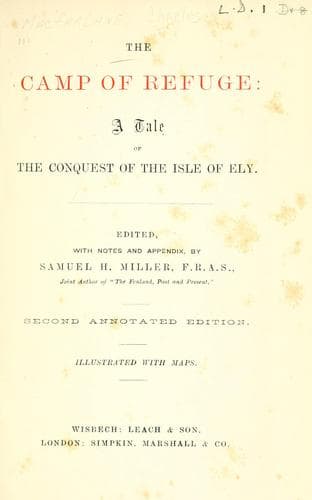
The Camp of Refuge: A Tale of the Conquest of the Isle of ElyMacFarlane, Charles
History
The Camp of Refuge: A Tale of the Conquest of the Isle of Ely
MacFarlane, Charles
Great Britain -- History -- Medieval period, 1066-1485 -- Fiction
been captured with him in the marsh. Add to all this that the Normans,
who had not before tried what it was to make war in the fens, had a
contempt of their enemy, and a measureless confidence in their own
skill and prowess, and it will be understood that their discomfiture
was unavoidable. They came down from the upland country in separate
bodies, and towards points far apart; and before they could place
themselves, or contract their intended circle and give the hand to one
another, Hereward attacked them separately, and beat them one by one.
Nor did the Normans fare much better when they gave up their plan of
circle and united their forces in one head. The Lord of Brunn, who had
counted upon being driven from Spalding into the wilderness, found not
only that he could maintain himself there, but that he could also hold
his own good house at Brunn; for, when the Norman host marched upon
that manor, they fell into an ambuscade he had laid for them, and
suffered both loss and shame, and then fled from an enemy they had
hardly seen; for the fenners had willow-trees for their shields, or
they had bent their bows in the midst of the tall growing rushes. Thus
passed the summer months; and Duke William[255] was still on the
northern borders, fighting against Malcolm Caenmore; and as that Scots
war became more and more obstinate, the Duke was compelled to call to
his aid nearly the whole of his splendid chivalry, and almost every
Norman foot-soldier that he could prudently withdraw from England. With
such mighty forces Duke William marched from the left bank of the Tweed
to end of the Frith of Forth, and all through the Lothians; and
thereupon the Scots king, albeit he would not deliver up the Saxon
nobles who had taken refuge at his court, came and agreed with Duke
William, and delivered hostages, and promised to be his man. But by
this time another year was spent, and the fens were again
impracticable; and, moreover, the Norman conqueror was compelled to
tarry long at Durham, in order to settle the North country. Before the
quinzaine of this Nativity the goodly stock of Lord Hereward was
increased by the birth of a daughter, and Elfric was a father. The two
children were baptized on the same day; and at the feast, which was
given in the same hall at Spalding wherein Ivo Taille-Bois and the
Ladie Lucia had given their great feast for the christening of their
first-born, the merry sword-bearer said, “Well, we be still here! and
it is now my opinion that I shall be a grandfather before the Normans
shall drive us out of the fens!” The carefully guarded Norman prisoners
of rank and note were very sad; but Ivo Taille-Bois was the saddest of
them all on this festal day, for his wife and child were far away from
him, living under the protection of the primate Lanfranc at Canterbury,
and, much as he had tried, he could get no news of them; nor could he
see any prospect of regaining his liberty, inasmuch as the Lord of
Public-domain text, read in full here on John Shaqi.
Reviews
Reviews
No reviews yet
Be the first to share your thoughts on this work.
Elsewhere in the archive
Join the Discussion
Join the discussion
Sign in to leave a comment or review.
Sign InorCreate an account