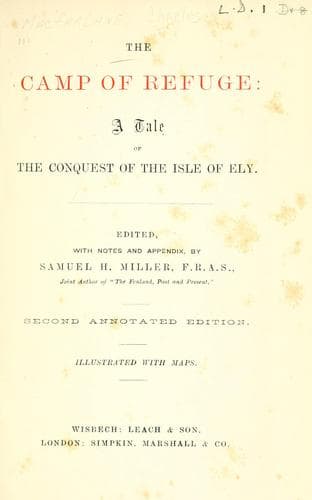
The Camp of Refuge: A Tale of the Conquest of the Isle of ElyMacFarlane, Charles
History
The Camp of Refuge: A Tale of the Conquest of the Isle of Ely
MacFarlane, Charles
Great Britain -- History -- Medieval period, 1066-1485 -- Fiction
pronounced with his right hand laid upon the relics of the Saxon saints
he most esteemed, to be henceforward and alway true liegeman to King
William and to his lawful successors.
When a Saxon monk, known for his good English heart, and for the pious
life he had led in Waltham Abbey,[258] got into the fen country, and
into the presence of the Lord of Brunn with this scroll, the gentle
Ladie Alftrude, who had borne many toils and troubles without a murmur,
was lying sick of a marsh fever, which she had caught in Hoiland. This
afflicting event was calculated to have some influence over her lord’s
decision; but many other events and circumstances, too numerous to
name, all led to the same conclusion. No hope of the return of King
Harold could be maintained any longer; the good old Saxon monk from
Waltham vowed that his body was really buried in Waltham Abbey, that
the river Lea, flowing fast by that Abbey gate, ever murmured his
requiem, by night as by day, and that he himself, for years past, had
said a daily mass for the peace of his soul. All the great Saxon chiefs
had submitted long ago; Earl Waltheof, the last that had made a stir in
arms, had been captured and beheaded outside Winchester town, and was
now lying (though not without a strong odour of sanctity) in a deep
grave at Crowland Abbey; Edgar Etheling, the last representative of the
line of King Alfred, was living contentedly, and growing fat in a
Norman palace at Rouen, with a pound of silver a day for his
maintenance; for he had long since given himself up, and sworn himself
liege-man to William. Every rising had been put down in England, and
all conditions of men seemed determined to rise no more, but to live in
peace and good fellowship with the Normans; there was nothing but
marrying and giving in marriage between the two races, and Saxon lords
and other men of note were taking unto themselves Norman or French
wives; and the great father of the whole Christian church, the Pope at
Rome, Gregory, the seventh of that name, had given plenary powers to
Archbishop Lanfranc to reorganize the Saxon church, and to
excommunicate all such Saxons as submitted not to his primacy and to
the government established. William, on the other hand, promised to
take vengeance on none of Lord Hereward’s followers, and to injure no
fen-man for that which was past.
“Elfric,” said the Lord of Brunn, “I think we must accept these terms,
and cease this roving life among woods and meres. We have done what
brave men can do: we have shown the Normans that England was not
conquered in one fatal battle. We might yet hold out here, but for the
rest of England we can do nothing; and our being here costs some
Englishmen in the vicinage very dearly! What sayest thou, my
ever-trusty sword-bearer? Wilt follow thy old master to London city,
and make peace with Duke William and his Normans, who have never been
able to overcome us?”
Public-domain text, read in full here on John Shaqi.
Reviews
Reviews
No reviews yet
Be the first to share your thoughts on this work.
Elsewhere in the archive
Join the Discussion
Join the discussion
Sign in to leave a comment or review.
Sign InorCreate an account