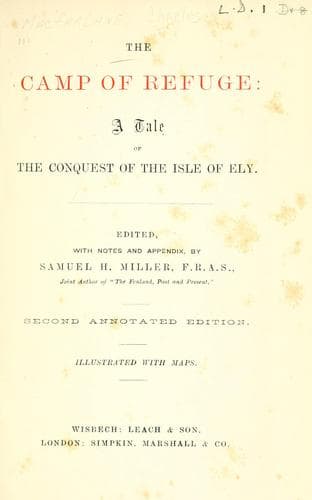
The Camp of Refuge: A Tale of the Conquest of the Isle of ElyMacFarlane, Charles
History
The Camp of Refuge: A Tale of the Conquest of the Isle of Ely
MacFarlane, Charles
Great Britain -- History -- Medieval period, 1066-1485 -- Fiction
Quoth Elfric, “Where my lord goes there go I, be it to London city or
to London tower. I think we have shown the Normans that England was not
won by the battle of Hastings. An the Duke keep but his faith, we may
live freely and happily in the good old house at Brunn, and among our
honest fen folk.”
Of the monks who had fled from Ely with Elfric some were dead, but the
gentle and good Father Elsin and the fiery and old Father Kenulph, and
several of the lay-brothers were yet alive; and therefore Hereward told
the Duke’s emissary, the good monk from Waltham, that their must be an
especial agreement to relieve these monks of Ely from the rules of
their order, and allow them to abide at Brunn or at Ey. The emissary
was further told that, before Lord Hereward would submit, Duke William
must swear upon the relics of his saints to observe the paction, to be
true to every article of the agreement: and to give an earnest of his
own sincerity and truth, the Lord of Brunn swore in the solemnest
manner that he was ready to accept the conditions offered to him; and
that, having once accepted them, nothing but treachery and violence on
the other side would ever make him swerve from them so much as the
breadth of a hair.
The monk of Waltham went his way unto London; and in as short a time as
might be he came back again as far as the succursal cell at Spalding,
attended by a goodly company of Norman and Saxon nobles, who came to
bear witness that Lanfranc and the chancellor of the kingdom had put
their signatures to the scroll as well as the king, and that William
had sworn in their presence to be faithful to the deed. Now the Lord of
Brunn went to Spalding with a goodly retinue of armed men, but not more
numerous than the party which had come thither with the monk of
Waltham; and having heard all that the monk and the lords had to tell
him, and having carefully perused the deed (for Hereward had tasted
books, and could read well in Latin), he wrote his name to the deed,
and some of the principal men with him wrote their names; and then he
swore upon the relics to be liege-man to _King_ William. And now
William the Norman might in truth be called a king, and king of all
England. It was in the Kalends of October, in the year of grace one
thousand and seventy-six, and ten years after the great assize of God’s
judgment at Hastings, that this thing was done and an end put to the
resistance of the Saxons.
Public-domain text, read in full here on John Shaqi.
Reviews
Reviews
No reviews yet
Be the first to share your thoughts on this work.
Elsewhere in the archive
Join the Discussion
Join the discussion
Sign in to leave a comment or review.
Sign InorCreate an account