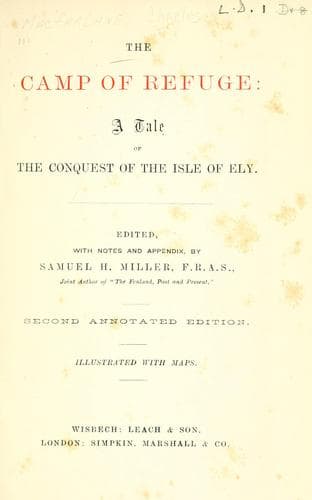
The Camp of Refuge: A Tale of the Conquest of the Isle of ElyMacFarlane, Charles
History
The Camp of Refuge: A Tale of the Conquest of the Isle of Ely
MacFarlane, Charles
Great Britain -- History -- Medieval period, 1066-1485 -- Fiction
APPENDIX.
NOTE A.—(_Page 5._)
FOUNDATION OF ELY ABBEY.
Ely Abbey was founded by Ætheldreda in A.D. 673. She was the first
Abbess. Her right of rule over the Isle of Ely itself was derived from
her husband, Tonbert, a prince of the Gyrvii or Fen people. This
monastery rose to great importance—passed through various
vicissitudes—incident to the times of invasion and conflict—was
heroically defended at various periods—submitted to the power of Duke
William, was converted into a Bishopric in 1109—Hervey being its first
prelate—and shared the fate of other monastic houses in the reign of
Henry VIII., when its revenue amounted to about £13,000 per year, at
the present value of money.[259]
NOTE B.—(_Page 5._)
THE LEGEND OF S. LUCY.
Saint Lucia was a native of Syracuse; her hand was sought in marriage
by a young nobleman whose suit she refused, whereupon her lover
complained that her beautiful eyes haunted him day and night; she cut
them out and sent them to him, begging to be allowed to persue her
religious aspirations unmolested, hence she is often represented with
the balls of her eyes laid on a dish; perhaps her eyes were defaced or
plucked out—though her present “Acts” make no mention of any such
circumstance. In many places her intercession was particularly implored
for distemper of the eyes, (for, as a recompense for this self
abnegation, Heaven restored her eyes making them more beautiful than
before).
Her chief offence may have been that she bestowed the whole of her
large wealth on the poor instead of sharing it with her suitor who
accused her to the governor of professing Christianity and in
consequence she suffered in the Diocletian persecution. She appears to
have died in prison, of wounds, on 13th December, 304, A.D. In the 6th
century she was honoured at Rome among the most illustrious virgins
whose triumphs the church celebrates, as appears from the Sacramentary
of St. Gregory, Bede, and others. Her festival was kept in England,
till the change of religion, as a holiday of the second rank on which
no work but tillage or the like was allowed. Her body remained at
Syracuse for many years. She is often represented with a palm branch in
one hand and a burning lamp in the other, expressive of her name which
means Light, in Greek, λύκη. _“Notes Ecclesiological and Historical
on the Holy Days,” London, 1864, also “Lives of the Saints,” by Rev.
Alban Butler._
[Illustration: THE GROUND PLAN OF THE AREA OF SPALDING MONASTERY.
(_From the “Monasticon.”_)
A—Situs Abbatæ (the Site of the Abbey).
B—Clavicularium (the Gate House).
C—Horreum (the Store-house or Barn).
D—Turris (the Tower).
E—Forum Mercatorium (the Market).
F—Pons Altus (the High Bridge).
G—Welland Flumen (the River Welland).
H—Fossa (a Trench).
I—Pons Irinus (the Lily Bridge).
K—Aqua vocata Westload (the Stream called the Westlode).
Public-domain text, read in full here on John Shaqi.
Reviews
Reviews
No reviews yet
Be the first to share your thoughts on this work.
Elsewhere in the archive
Join the Discussion
Join the discussion
Sign in to leave a comment or review.
Sign InorCreate an account