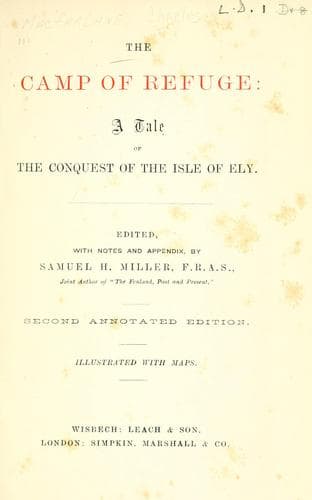
The Camp of Refuge: A Tale of the Conquest of the Isle of ElyMacFarlane, Charles
History
The Camp of Refuge: A Tale of the Conquest of the Isle of Ely
MacFarlane, Charles
Great Britain -- History -- Medieval period, 1066-1485 -- Fiction
elevation of the fair Maud to the throne filled the hearts of the
English with joy, for not only was she their countrywoman and a
descendant from the royal stock of Alfred the Great, but she was also
at the time of her marriage beautiful in person, charitable unto the
poor, and distinguished above all the ladies of her time by a love for
learning and learned men. Elfric the sword-bearer, who was yet in the
prime vigour of life, brought to mind the dying prediction of Frithric
the Abbat of St. Albans, and said joyously to his lord, that “England
would be England still, and that the Saxon tongue and laws were things
that could not be rooted out!”
“Elfric,” said Lord Hereward, “the great stream of our old Saxon blood
is fast absorbing the less stream of Norman blood, and so will it
continue to do. The children of Normans, being born in England and
suckled by Saxon nurses, will cease to be Normans. All men love to keep
that which they have gotten; and as our old Saxon laws are far more
free than those of France, and give more security for life and goods,
and oppose a stronger barrier to the tyranny of princes, the Normans
that now live among us, or their sons that shall succeed them, will,
for their own sakes, cling to our old laws, and help the chiefs and the
great body of the English people to make the spirit of them to be
enduring in the land.”
Thus talked the Lord of Brunn and his faithful sword-bearer; and thus
they lived to teach their children’s children.
Hereward continued to live comfortably and peaceably with his
neighbours and with all men, and he died in peace after he had lived
many more years. Both he and the Ladie Alftrude reached a patriarchal
age, and they left a patriarchal stock behind them. They were buried
with all honour in Crowland Abbey, which, by this time, had become a
holier and a better governed house than ever it had been before. A
learned monk of Crowland wrote good verses in Latin upon the tombstone
of the Lord of Brunn; but we find in our own home tongue lines which
might have been a still better epitaph:—
Him loved young, him loved old,
Earl and baron, dreng and kayn,
Knight, bondeman, and swain,
Widows, maidens, priests, and clerks,
And all for his good werkes.
He loved God with all his might,
And holy kirk and soothe and right.
And that there might be a lasting record of his prowess in battle and
skill in war, his good and learned mass-priest Alefricus Diaconus, had
written before he died, and in the same old English tongue, a goodly
book of the deeds of Hereward, the great soldier; and albeit this
goodly book, by some evil chance, hath disappeared, Hugo Candidus and
Robert of Swaffham, two right learned monks of the abbey of
Peterborough, have put the substance of it, and such portions as could
be found, into their treatise intituled, DE GESTIS HEREWARDI INCLYTI
MILITIS.
Public-domain text, read in full here on John Shaqi.
Reviews
Reviews
No reviews yet
Be the first to share your thoughts on this work.
Elsewhere in the archive
Join the Discussion
Join the discussion
Sign in to leave a comment or review.
Sign InorCreate an account