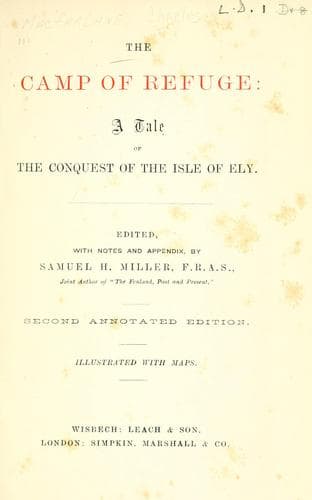
The Camp of Refuge: A Tale of the Conquest of the Isle of ElyMacFarlane, Charles
History
The Camp of Refuge: A Tale of the Conquest of the Isle of Ely
MacFarlane, Charles
Great Britain -- History -- Medieval period, 1066-1485 -- Fiction
King Offa is said to have exhumed the body, placed it in a magnificent
shrine, and established monks to watch over it in 793; but Bede says
that a church was established where the martyrdom took place in 731
A.D.; and Offa is believed to have designed a nobler church which
perhaps was not completed by him, but by Eadmer, the 9th Saxon Abbat,
and this church existed at the time of the Norman conquest.
Paul of Caen, appointed by Lancfranc in 1077 “pulled down the Saxon
building and constructed the church entirely anew of stones and tiles
taken from the ancient Roman city of Verulam, a great portion of which
had been collected by the two last Saxon Abbots.” (Frithric, mentioned
in note on page 20, being one of them.)
This, then, was substantially the same church which has been restored
in these modern times and which became the Cathedral of the new diocese
of S. Albans in 1877, when Dr. Claughton was enthroned as Bishop.
The reader will find valuable information in
1. _A History of the Abbey of S. Alban_, by DR. NICHOLSON.
2. _Report on the Lady Chapel of S. Alban_, by SIR GILBERT SCOTT.
3. _The Restoration of the Abbey of S. Alban_, by J. CHAPPLE, 1874.
4. _The Restoration of the Abbey Church of S. Alban_, 1876.
5. _A short History of the Abbey Church of S. Alban_, by J. CHAPPLE,
1882.
NOTE G.—(_Page 59_).
CROWLAND ABBEY.
Crowland Abbey was founded by Æthelbald in 716, according to a promise
made to the hermit Guthlac who lived there in seclusion for 15 years.
The reader will find an account of this recluse in Ordericus who
followed what was written by bishop Felix. Ordericus says that the name
of Guthlac signified “the gift of war,” and that he belonged to a tribe
called Guthlacingas. Gudlacus is the spelling in William of Malmesbury.
Ordericus gives his own account of the building of Crowland Abbey as he
learnt it on the spot.
Æthelbald sent for Kenulph, a monk of Evesham, and granted to him the
whole island of Crowland, for the purpose of congregating and
supporting a society of monks exempting it for ever from all secular
payments and services. _Dugdale’s Monasticon._
NOTE H.—(_Page 61._)
RAMSEY ABBEY.
Ramsey Abbey was founded by St. Oswald and Æthelwine of East-Anglia, in
969.[260] The Abbey was dedicated to SS. Mary and Benedict and was
occupied by the order of “Black Monks.” It became richly endowed to the
annual value of about £18000 of present money.
NOTE I.—(_Page 61._)
THORNEY ABBEY.
Public-domain text, read in full here on John Shaqi.
Reviews
Reviews
No reviews yet
Be the first to share your thoughts on this work.
Elsewhere in the archive
Join the Discussion
Join the discussion
Sign in to leave a comment or review.
Sign InorCreate an account