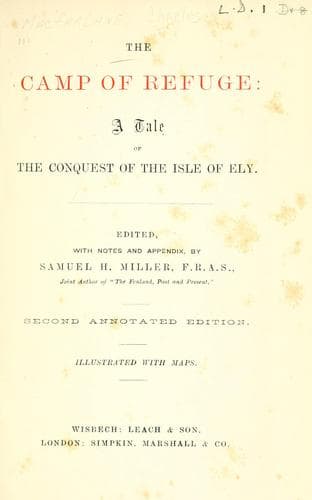
The Camp of Refuge: A Tale of the Conquest of the Isle of ElyMacFarlane, Charles
History
The Camp of Refuge: A Tale of the Conquest of the Isle of Ely
MacFarlane, Charles
Great Britain -- History -- Medieval period, 1066-1485 -- Fiction
Thorney.—This spot appears to have been selected for the establishing
of a religious house at the time that Wulphere and his kin went to the
consecration of the church at Peterborough.[261] Abbot Saxulf requested
of that Mercian king a grant of Thorney, saying—“There is an island
here which is called ANCARIG, and my desire is that we build a minster
there to the glory of S. Mary, so that those may dwell therein who wish
to lead a life of peace and rest.”
Thus it would seem that in 662 A.D. this fen island (Thorney now) was
“Ancarig,” or “Hermit’s isle,”[262] and how long before we know not.
Hermits—we suppose—developed into monks. Keltic Christians may have
chosen a life of seclusion, and to some of them Thorney may have been a
hermitage.
_Ancarig_ seems allied to the Saxon words, “ANCER,” a hermit or
recluse; and “_ig_,” an island.
But there are similar elements in the Welsh language, as “ANCR,” a
hermit; and “UNIG,” lonely, out of the way;—(also “_ing_,” narrow or
confined.)
Therefore, “Ancarig” may have been so named—may have been a
hermitage—in what are called old British times, _i.e._ prior either to
the Roman conquest or the Saxon supremacy. The derivation was probably
quite independent of the Greek forms, _ana_ and _choreo_, from which
our modern word, Anchorite, is supposed to come.
Thorney, in common with other monasteries, suffered during the Danish
invasions, but revived in the peaceful reign of Ædgar.
Athelwold, bishop of Winchester, established himself at Thorney about
964, and according to William of Malmesbury he gained possession of
land sufficient to maintain himself and 12 monks (Iccircoque nontantum
terrarum illuc, quantum alibi congessit; sed quantum sibi et. XII.
monachis sat esset.)
To effect this he is said to have cleared the land of the thorns and
brambles.
The following lines are from _Novæ Arundines or New Marsh-Melodies_, by
H. HAILSTONE, M.A. Palmer, Cambridge. 1885.
THORNEY ABBEY.
Ah! mute is Thorney’s matin bell,
And hushed the holy singing
That rose from out the hermits’ cell,
In tuneful numbers ringing!
Delightsome was that isle of yore,
Where apples without measure
Did bloom, and Phœbus panted o’er
The vineyard’s purple treasure!
Beneath the bosom of the eyot
In pleasing holts embower’d,
The tippet-grebes did congregate,
The snow-white heron tower’d.
Now all their water-ways are dry;
Then sit we ’twixt the setting
Of yon bright orb that gilds the sky,
And Cynthia’s crystal fretting.
Behold how Ceres’ lap is full:
O may no fortune fickle
The bounteous goddess’ gifts annul,
Or stint the golden sickle!
Public-domain text, read in full here on John Shaqi.
Reviews
Reviews
No reviews yet
Be the first to share your thoughts on this work.
Elsewhere in the archive
Join the Discussion
Join the discussion
Sign in to leave a comment or review.
Sign InorCreate an account