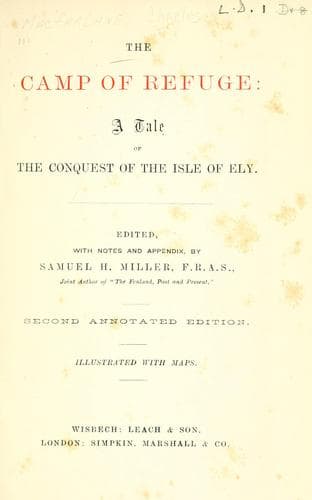
The Camp of Refuge: A Tale of the Conquest of the Isle of ElyMacFarlane, Charles
History
The Camp of Refuge: A Tale of the Conquest of the Isle of Ely
MacFarlane, Charles
Great Britain -- History -- Medieval period, 1066-1485 -- Fiction
Though all were eager to be informed of the strength which the Lord of
Brunn brought with him, and of the plans he proposed to pursue,
Thurstan thought it churlish to question any man fasting. Hereward,
however, declared that he had fared well on board the bark, and could
well wait till supper-time. And so, having closed the doors of the
abbat’s great hall, the lords and prelates proceeded to deliberate with
the dispossessed Lord of Brunn. The sum of Hereward’s replies to many
questions and cross-questions (he having no genius for narration) was
simply this:—Elfric had found him out in Flanders, and had delivered
to him letters, and messages, and tokens which had determined him to
quit his adoptive country and return to England. Many English exiles
who had been living in the Netherlands had made up their minds to come
over with him. Such money as they could command among them all, or
borrow at interest from the traders of Flanders, who seriously felt the
loss of their trade with England, had been applied to the purchase of
warlike harness, and to the hiring and equipping of three foreign
barks. The master of a bark from Lynn that chanced to be in those parts
had offered his bark and the services of himself and crew for nothing,
or for what his liege lord the Abbat of Ely might at any time choose to
give him. The gold and silver which my Lord Abbat had sent with Elfric
had been properly and profitably employed; and, besides spear-heads,
and swords, and bows, and jackets of mail, the Lynn bark now lying at
my Lord Abbat’s pier, and the other Lynn bark left behind at that town,
had brought such a quantity of Rhenish and Mosel wine as would suffice
for the consumption of the whole house until next Christmas. Counting
the men that had come in all the barks, there were more than one
hundred and ten true-hearted Saxons, well armed and equipped, and well
practised in the use of arms, as well in the Saxon fashion as in the
fashions used abroad; and every one of these men was proper to become a
centurion, or the trainer and leader of a hundred of our fen-men. It
was Lord Hereward’s notion that our great house at Ely and the Camp of
Refuge would be best relieved or screened from any chance of attack, by
the Saxons making at once a quick and sharp attack all along the Norman
lines or posts to the north and north-west of the Isle of Ely, or from
Spalding to Brunn, and Crowland, and Peterborough. Some thought that
his lordship preferred beginning in this direction because his own
estates and the lady of his love were there: we will not say that these
considerations had no weight with him, but we opine that his plan was a
good one, and that no great commander, such as Hereward was, would have
begun the war upon the invaders in any other manner, time or place.
Twenty of the armed men he had brought with him from their wearisome
exile—or more than twenty if my Lord Abbat thought fit—he would leave
Public-domain text, read in full here on John Shaqi.
Reviews
Reviews
No reviews yet
Be the first to share your thoughts on this work.
Elsewhere in the archive
Join the Discussion
Join the discussion
Sign in to leave a comment or review.
Sign InorCreate an account