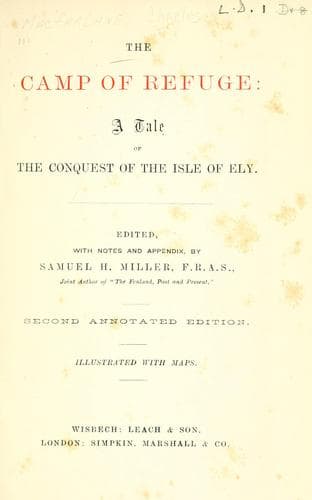
The Camp of Refuge: A Tale of the Conquest of the Isle of ElyMacFarlane, Charles
History
The Camp of Refuge: A Tale of the Conquest of the Isle of Ely
MacFarlane, Charles
Great Britain -- History -- Medieval period, 1066-1485 -- Fiction
“But” said Hereward, “in proposing to leave you this strange man from
Italie, I thought of taking from you, for yet another while, that Saxon
wight Elfric, seeing that he knoweth all this fen country better than
any man in my train; and that, while I am going round by the river and
the Wash, I would fain despatch, by way of the fens, a skilled and
trustful messenger in the direction of Ey....”
“To salute the Ladie Alftrude, and to tell her that thou art come,”
said the Abbat of Crowland.
“Even so,” quoth Hereward; “and to tell her moreover to look well to
her manor-house, and to let her people know that I am come, and that
they ought to come and join me at the proper time.”
“It is clear,” said the Prior of Spalding, “that none can do this
mission an it be not Elfric, who knoweth the goings and comings about
the house at Ey....”
“Aye, and the maid-servant that dwelleth within the gates,” quoth the
Abbat of Crowland.
The Prior of Spalding laughed, and eke my Lord Abbat of Ely; and when
he had done his laugh, Thurstan said “This is well said, and well
minded; and as we seem to be all agreed that, upon various
considerations, it would be better to unfrock the young man at once,
let us call up Elfric, and release him from his slight obligations, and
give him to Lord Hereward to do with him what he list. What say ye my
brothers?”
The two dignified monks said “yea;” and Elfric being summoned was told
that henceforth he was Lord Hereward’s man, and that he might doff his
cucullis,[121] and let his brown locks grow on his tonsure as fast as
they could grow.
The monk that sleeps in his horse-hair camise,[122] and that has
nothing to put on when he rises but his hose and his cloak, is not long
a-dressing; yet in less time than ever monk attired himself, Elfric put
on the soldier garb that he had worn while abroad. And then, having
received from Hereward a signet-ring and other tokens, and a long
message for the Ladie Alftrude, together with instructions how he was
to proceed after he had seen her; and having bidden a dutiful farewell
and given his thanks to the Prior of Spalding and to the two abbats,
and having gotten the blessing of all three, Elfric girded a good sword
to his loins, took his fen-staff in his hand, and went down to the
water-gate to get a light skerry, for the country was now like one
great lake, and the journey to Ey must be mostly made by boat.
It was now nigh upon day-dawn. The Lord Abbat and a few others
accompanied the Lord of Brunn to the pier, and saw him on board: then
the mariners let go their last mooring, and the bark began to glide
down the river.
Before the light of this winter day ended, Hereward was well up the
Welland, and the whole of his flotilla was anchored in that river not
far from Spalding, behind a thick wood of willows and alders, which
sufficed even in the leafless season to screen the barks from the view
of the Norman monks in the succursal cell.
Public-domain text, read in full here on John Shaqi.
Reviews
Reviews
No reviews yet
Be the first to share your thoughts on this work.
Elsewhere in the archive
Join the Discussion
Join the discussion
Sign in to leave a comment or review.
Sign InorCreate an account