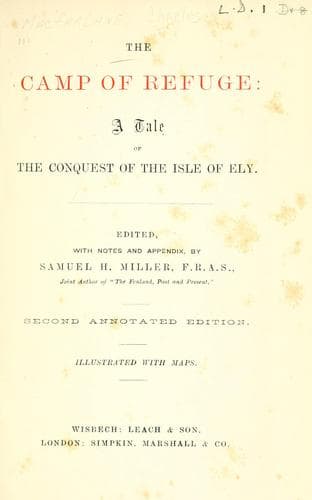
The Camp of Refuge: A Tale of the Conquest of the Isle of ElyMacFarlane, Charles
History
The Camp of Refuge: A Tale of the Conquest of the Isle of Ely
MacFarlane, Charles
Great Britain -- History -- Medieval period, 1066-1485 -- Fiction
Hereward smiled and said, “Assuredly he was but saying a prayer in his
own tongue. My Lord Abbat, this Girolamo of Salerno, hath lived
constantly with me for the term of two years, and I will warrant him as
true a believer as any man in broad England. He is a man of many
sorrows, and no doubt of many sins; but as for his faith!—why he is a
living and walking history of all the saints and martyrs of the church,
and of every miraculous image of Our Ladie that was ever found upon
earth. His troubles and his crosses, and his being unable to speak our
tongue, or to comprehend what is said around him, may make him look
moody and wild, and very strange: and I am told that in the country of
his birth most men have coal-black hair and dark flashing eyes; but
that in Salerno there be no Israelites allowed, and no necromancers or
warlocks or witches whatsoever; albeit, the walnut-tree of Beneventum,
where the witches are said to hold their sabbat, be not very many
leagues distant. In truth, my good Lord Abbat, it was but to serve you
and to serve your friends and retainers, that I proposed he should stay
for a season where he is; for I have seen such good proofs of his skill
in the stratagems of war, and have been promised by him so much aid and
assistance in the enterprises I am going to commence, that I would fain
have him with me. I only thought that if he stayed a while here in
quiet, he might learn to speak our tongue; and that if during my
absence the Normans should make any attempt from the side of Cam-Bridge
upon this blessed shrine of Saint Etheldreda, he might, by his
surpassing skill and knowledge of arms, be of use to your lordship and
the good brothers.”
“These are good motives,” said Thurstan, “and do honour to thee, my
son. It is not in my wont to bid any stranger away from the house....
But—but this stranger doth look so very strange and wild, that I would
rather he were away. Even our sub-sacrist, who hath not the same nature
as the prior and cellarer, saith that all our flaxen-headed novices in
the convent are afraid of that thin dark man, and that they say
whenever the stranger’s large black eye catches theirs they cannot
withdraw their eyes until he turns away from them. I think, my Lord
Hereward, the stranger may learn our tongue in thy camp. I believe that
the Normans will not try on this side now that the waters are all out,
and our rivers and ditches so deep; and if they do we can give a good
account of them—and I really do think that thou wilt more need than we
this knowing man’s services:—what say ye, my brother of Crowland?”
The Abbat of Crowland was wholly of the opinion of the Abbat of Ely,
and so likewise was the Prior of Spalding. It was therefore agreed that
Girolamo of Salerno should accompany the young Lord of Brunn.
Public-domain text, read in full here on John Shaqi.
Reviews
Reviews
No reviews yet
Be the first to share your thoughts on this work.
Elsewhere in the archive
Join the Discussion
Join the discussion
Sign in to leave a comment or review.
Sign InorCreate an account