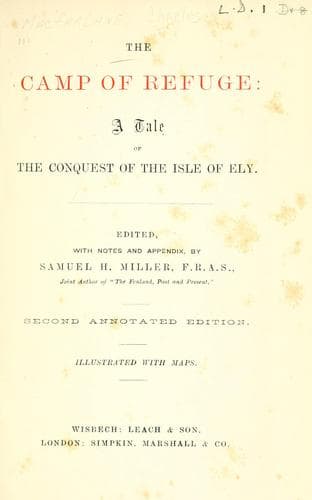
The Camp of Refuge: A Tale of the Conquest of the Isle of ElyMacFarlane, Charles
History
The Camp of Refuge: A Tale of the Conquest of the Isle of Ely
MacFarlane, Charles
Great Britain -- History -- Medieval period, 1066-1485 -- Fiction
A feast was prepared in the great hall of the manor-house, and the
young Lord of Brunn was about sitting down to table with his kinsmen
and the good friends that had rallied round him in the hour of need,
when Elfric arrived at Brunn from the house of the Ladie Alftrude at
Ey. To look at Lord Hereward’s glad countenance as he talked in a
corner of the hall with the new comer, one would have thought that he
had won a fairer house and a wider domain than those of his ancestors
of which he had repossessed himself in the morning. And for that matter
he had won or was winning his way to a better house and greater estate;
for had not the fair young heiress of Ey sent again to tell him that
she abided by her troth-plight, and looked for him to come and rescue
her from that burthensome and dishonouring protection of the Normans
under which she had been living! The retainers of her father’s house,
and all the hinds and serfs, were devoted to her, and ready to receive
the young Lord of Brunn as their own liege lord and deliverer. Her
friends and neighbours had all been consulted, and would assemble in
arms and meet Lord Hereward at any hour and place that it might suit
him to name. Save some few men-at-arms that were at Crowland to protect
the intrusive Norman monks, there was no Norman force nearer to Ey than
Stamford. The season of the year and all things were favourable for
recovering the whole of the fen-country, and for driving the invaders
from every country in the neighbourhood of the fens.
After putting a few questions to Elfric, such as lovers usually put to
their pages when they come from seeing their ladie-loves, Hereward
asked what force there might be in Crowland Abbey. Elfric said that
there might be one knight and from ten to fifteen men-at-arms; but then
all the monks that had been so recently brought over from France were
fighting men, at a pinch; and these intruders were from thirty to forty
in number, and well provided with weapons and warlike harness. The
young man also bade Lord Hereward reflect that the great house at
Crowland was not like the cell at Spalding, but a lofty and very strong
place, and built mostly of stone and brick. Elfric too had learned that
Crowland was well stored with provisions, so that it might stand a long
siege.
“And yet,” said the Lord of Brunn, “it is upon the great house of
Crowland that I would fain make my next attempt; and great in every way
are the advantages that would follow the capture of that strong and
holy place, and the immediate restoration of the true Saxon Lord Abbat
and his dispossessed brethren.”
“My silly head hath been venturing to think of this,” said Elfric, “and
I very believe that with the aid of Girolamo and with a little of that
blue fire and stinking smoke which he hath the trick of making, I could
drive knight, men-at-arms, and monks all out of the abbey without any
loss or let to our good Saxons.”
“Why, what wouldst do?” said Hereward.
Public-domain text, read in full here on John Shaqi.
Reviews
Reviews
No reviews yet
Be the first to share your thoughts on this work.
Elsewhere in the archive
Join the Discussion
Join the discussion
Sign in to leave a comment or review.
Sign InorCreate an account