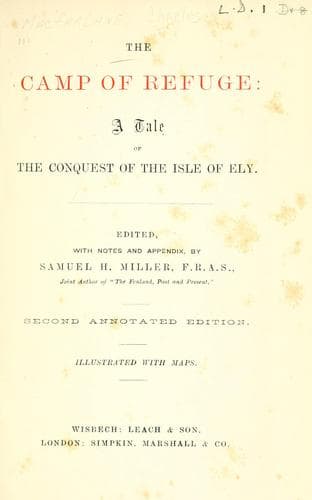
The Camp of Refuge: A Tale of the Conquest of the Isle of ElyMacFarlane, Charles
History
The Camp of Refuge: A Tale of the Conquest of the Isle of Ely
MacFarlane, Charles
Great Britain -- History -- Medieval period, 1066-1485 -- Fiction
Compared with Crowland, Ely was quite a dry place: there the abbey
church and conventual buildings stood upon a hill and on firm hard
ground;[132] but here all the edifices stood upon piles driven into the
bog, and instead of a high and dry hill, there was nothing but a dead
wet flat, and unless in those parts where the monastery and the town
stood the ground was so rotten and boggy that a pole might be thrust
down thirty feet deep. Next to the church was a grove of alders, but
there was nothing else round about but water and bogs, and the reeds
that grow in water. In short this Crowland, both in the situation and
nature of the place, was a marvel even in the fen-country; and, certes,
it was different from all places in any other part of England. Lying in
the worst part of the fens, it was so enclosed and encompassed with
deep bogs and pools, that there was no access to it except on the north
and east sides,[133] and there too only by narrow causeways. Even in
the summer season the cattle and flocks were kept at a great distance,
there being no pasture-land upon which they could be placed without
danger of seeing them swallowed up; so that when the owners would milk
their cows they went in boats, by them called skerries, and so small
that they would carry but two men and their milk-pails. There was no
corn growing within five miles of Crowland. The greatest gain was from
the fish and wild-ducks that were caught; and the ducks were so many
that the Crowland fowlers could at times drive into a single net three
thousand ducks at once; and so the good people called these pools their
real corn-fields.[134] For this liberty of fishing and fowling they
paid yearly to the Lord Abbat a very round sum of money: and, we ween,
the abbat and the monks had ever the choice of the best fowls and
fishes they caught. That holy man Guthlacus, who had laid the Crowland
devils, and who had cut the sluices that led from the fetid pools to
the flowing rivers, had also made the causeways which gave access to
the town and monastery. These narrow but solid roads of wood and gravel
ran across the deepest marshes, and had willows and alders growing on
either side of them: they were marvellous works for the times; and do
we not see in our own day a pyramidal stone on the causeway leading to
the north, inscribed with the name of Guthlacus?[135] Much had this
beatified anchorite done to alter the face of the country; yet many of
the foulest pools remained and could not be purified. The town was
separated from the abbey by a broad stream, and three other streams or
water-courses flowed through the town,[136] separating the streets from
each other; the streets were planted with willows; and the houses
raised on piles driven into the bottom of the bog; and the people of
one street communicated with the people of another street by means of
light flying-bridges or by means of their skerries. A bold people they
were, and hardy and dexterous withal, for their lives were spent in
Public-domain text, read in full here on John Shaqi.
Reviews
Reviews
No reviews yet
Be the first to share your thoughts on this work.
Elsewhere in the archive
Join the Discussion
Join the discussion
Sign in to leave a comment or review.
Sign InorCreate an account