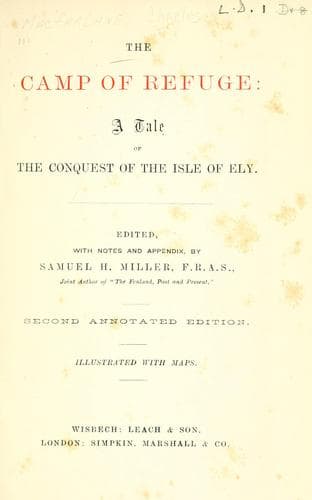
The Camp of Refuge: A Tale of the Conquest of the Isle of ElyMacFarlane, Charles
History
The Camp of Refuge: A Tale of the Conquest of the Isle of Ely
MacFarlane, Charles
Great Britain -- History -- Medieval period, 1066-1485 -- Fiction
hazardous fowling and fishing, and in toiling over measureless waters
and quagmires. Fenners must be bold and expert men, or they must
starve. Moreover the folk of Crowland town were very devout and
constant in their worship of the Saxon saints and had a laudable
affection for their dispossessed Saxon monks and Lord Abbat: although
in the time of King Edward, of happy memory, when they knew not what
real sorrow or trouble was, they would at times murmur to my Lord
Abbat’s chamberlain about the money they were called upon to pay, and
at times they would even quarrel lustily with the purveyors of the
house about eels and wild-ducks, pikes and herons, and such like
trivialities. But the usurping abbat from France had already nearly
doubled their rents and dues, and for every fish or fowl that the Saxon
purveyors had claimed, the Norman purveyors laid their hands upon a
dozen. Ye may judge, therefore, whether the good folk of Crowland town
did not abhor the Norman monks and wish them gone.
In turning away the good Lord Abbat and all his obedientiarii or
officials, and all his superior monks, the intruders had left in the
house a few inferior monks, and about half a score of servientes and
lay-brothers to hew their wood and draw their water. And they had so
overwrought these Saxon laics, and had so taunted and vilipended them,
that the poor hinds, one and all, wished them in the bottomless pit.
On the night after Lord Hereward’s feast at Brunn and the fifth night
from the festival of the Nativity, Alain of Beauvais, the intrusive
abbat, was feasting in the hall with his Norman friars, who had never
passed through a noviciate, and with his Norman men-at-arms, who were
neither more nor less godly than his monks. One or two of the English
laics were waiting upon these their lords and masters; the other
lay-brothers were supposed to be gone to their straw beds. Alain the
pseudo-abbat, being warm with wine, was talking in the manner of all
Frenchmen about dames and demoiselles, and was telling his company what
a sweet lady it was that broke her heart when he first left Beauvais to
seek his fortune with Duke William. Just at this juncture of time there
came into the hall an invisible devil in the essence of a stink. It was
such a stench as mortal nose had never smelt before—it was so intense,
so foul and diabolical, that no mortal man could bear it long! Alain
the pseudo-abbat, putting both his hands to his nose, said, “Notre Dame
de la misericordi! what smell is this?” They all put their hands to
their nostrils, and roared “What stink is this?”
Public-domain text, read in full here on John Shaqi.
Reviews
Reviews
No reviews yet
Be the first to share your thoughts on this work.
Elsewhere in the archive
Join the Discussion
Join the discussion
Sign in to leave a comment or review.
Sign InorCreate an account