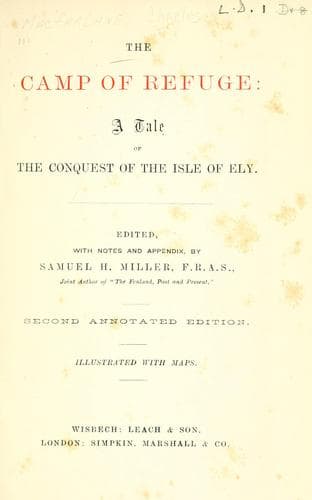
The Camp of Refuge: A Tale of the Conquest of the Isle of ElyMacFarlane, Charles
History
The Camp of Refuge: A Tale of the Conquest of the Isle of Ely
MacFarlane, Charles
Great Britain -- History -- Medieval period, 1066-1485 -- Fiction
fen-bogs, they got to the firm and dry causeway which the holy
Guthlacus had made for the use of better men. They were so exhausted by
the fatigue, fright, and agony of mind they had undergone, that they
all threw themselves flat upon the narrow road, and there lay in their
soaked clothes, and shivering in the cold winds of night. They were
still so near to Crowland that they could see bright lights, with
nothing blue or unearthly about them, streaming from the windows of the
abbey and from almost every house in the township, and could very
distinctly hear the ringing of the church bells and the shouting of
triumphant voices.
“The like of this hath not been seen or heard,” said Alain of Beauvais;
“the serfs of Crowland are in league with the devils of Crowland! The
Saxon rebels to King William have called the demons to their
assistance!”
“Nothing so clear,” said one of the men-at-arms, “but let my advice be
taken. The moon is rising now, therefore let us rise and follow the
road that lies before us, and endeavour to get out of these infernal
fens to the town of Huntingdon or to the castle at Cam-Bridge, or to
some other place where there be Normans and Christians. If the men of
Crowland should come after us, Saxons and slaves as they are, they may
drive us from this causeway to perish in the bogs, or cut us to pieces
upon the narrow road, for we have not so much as a single sword among
us all!”
“We have nothing,” groaned Alain of Beauvais.
“Aye,” grunted one of his friars, “we brought little with us and
assuredly we take less away with us! We be poorer than when we came and
drove the English abbat out of his house with nought but his missal and
breviary.”
“But we men-of-war depart much poorer than we came,” said one of the
soldiers; “for each of us brought a good stout English horse with him,
and arms and armour—and all these are left to the devils of Crowland;
and we shall all be laughed at for being devil-beaten, though how
men-at-arms can contend with demons I cannot discover. But hark! what
new din is that?”
The din was a roar of voices proceeding from Crowland town. It soon
came nearer, and still nearer; and then the hurried tramping of many
feet, and the tramp of horses as well as of men, were heard along the
causeway; and, as the moon shone out, the head of a dense moving column
was seen on the narrow road and sundry skerries or light skiffs were
seen gliding along the canals or broad ditches which ran on either side
the causeway; and shouts were heard of “Hereward for England! Hereward
for England!”
Public-domain text, read in full here on John Shaqi.
Reviews
Reviews
No reviews yet
Be the first to share your thoughts on this work.
Elsewhere in the archive
Join the Discussion
Join the discussion
Sign in to leave a comment or review.
Sign InorCreate an account