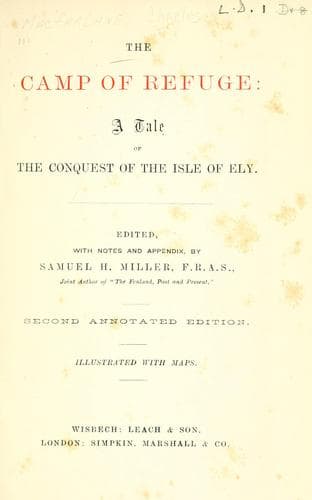
The Camp of Refuge: A Tale of the Conquest of the Isle of ElyMacFarlane, Charles
History
The Camp of Refuge: A Tale of the Conquest of the Isle of Ely
MacFarlane, Charles
Great Britain -- History -- Medieval period, 1066-1485 -- Fiction
Hereupon the Normans all rose from the cold ground, and began to run
with all the speed and strength that was left in them along the narrow
road, the hindmost hardly ever ceasing to cry “Misericordia,” or “Have
pity upon us, gentle Saxons!” But run as they would, the cry of
“Hereward for England” was close behind them; and the horses, being put
into a trot, broke in among them. More than one of the men-at-arms had
the mortification of being knocked down and ridden over by a Crowland
man mounted on his own war-horse; several of the monks got fresh
immersions in the canals. Had the Saxons so disposed, not a Norman of
all that company would have escaped with his life, for they were all as
helpless as babes in their swaddling-clothes. But Hereward of the true
English heart had conjured Elfric and the Salernitan to shed as little
blood and destroy as few lives as possible; and Girolamo well knew that
the terror and panic these fugitives would carry into whatsoever Norman
camp or station they went would do far more good to the good cause than
was to be done by despatching or by making prisoners of this score or
two of obscure rogues.
Thus Elfric, who led the van on a stately horse, called a halt when he
had carried his pursuit to some three miles from Crowland abbey. “And
now,” said he, “with the permission of good Guthlacus, we will cut such
a trench as shall prevent these robbers from returning to Crowland. So
dig and pull away, ye lusty fenners and nimble boys of Crowland that
lately made such good sham devils! Dig away for one good hour by this
bright moonlight, and to-morrow ye may make the trench broader and
deeper by daylight! Oh, Guthlacus, we will repair thy good work when
the good times come back again, and when honest men may walk along the
road in peace, without any fear of Norman cut-throats!”
Two score and more lusty hinds came forward with axes and spades and
mattocks; and within the hour a trench was dug quite broad and deep
enough to stop the march of any heavily armed man or war-horse. The
Saxons then returned to Crowland, and as they went they sang in chorus
a joyous war-song, and shouted “Hereward for England!”
Girolamo the Salernitan, who had remained in the abbey with the Saxon
lay-brothers, had put the house so completely in order and had so
cleansed it of the foul odours he had made by his art, and had so
sweetened it with frankincense brought from the church, and with barks
and fragrant spirits taken from his own packets, that no man could have
conceived that anything extraordinary had taken place. Save that the
good Lord Abbat and his cloister monks were missing, the whole house
looked just as it did before the Normans broke in upon it and drove
away the Lord Abbat and his brethren. Honest and merry English voices
rang again through hall, corridor, and cloister, instead of Norman
speech that whistles in the nose; and Saxon saints were once more
invoked instead of the unknown saints of France.
Public-domain text, read in full here on John Shaqi.
Reviews
Reviews
No reviews yet
Be the first to share your thoughts on this work.
Elsewhere in the archive
Join the Discussion
Join the discussion
Sign in to leave a comment or review.
Sign InorCreate an account