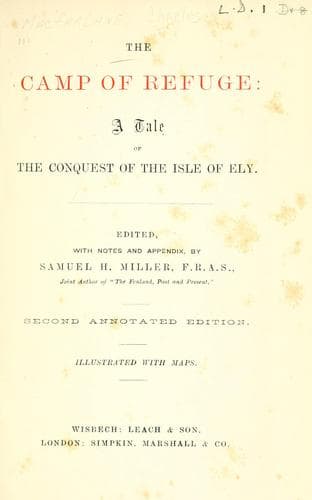
The Camp of Refuge: A Tale of the Conquest of the Isle of ElyMacFarlane, Charles
History
The Camp of Refuge: A Tale of the Conquest of the Isle of Ely
MacFarlane, Charles
Great Britain -- History -- Medieval period, 1066-1485 -- Fiction
Other men had been busy in the house besides the Salernitan and his
assistants. No joyful occurrence ever took place among the Saxons
without its being noted by a feast;—provided only that such good
Saxons had wherewith to feast upon. The Normans had gone off in much
too great a hurry to think of taking anything with them. In the buttery
remained, among other rich drinking-horns, all carved and ornamented
with silver, that famed horn which Witlaf,[139] king of Mercia, had
given from his own table to Crowland monastery, in order that the elder
monks might drink thereout on festivals, and in their benedictions
remember sometimes the soul of the donor. It was a mighty large horn,
such as became a great king: and it was an ancient custom of the house
that when any new Lord Abbat came they filled the horn with strong
wine, and offered to him to drink, and if he happened to drink it all
off cheerfully, they promised to themselves a noble Lord Abbat and many
good years in his time. Now for this high festival the subcellarer
brought forth this ancient and royal drinking-horn, which held twice
the quantity of our modern horns; and in order that there might be no
delay in filling it, the good subcellarer caused to be brought up from
below an entire cask of wine, and as soon as the cask was in the
refectory the head of it was stove in. Old Robin the cook, who had been
pastor and master in the art culinary to that good cook of Spalding,
had so bestirred himself, and had put so many other hands and feet in
motion, that there was a good supper ready for all of the house, and
all of the town, and all of the vicinage of Crowland who had been
aiding in the good work of disseising, now so happily accomplished; and
by the time Elfric and his friends got back to the monastery, the feast
was ready. The thin and dark Salernitan, being but a puny eater and no
drinker, and not fully versed in our vernacular, partook only of three
or four dishes and of one cup of wine; and then went straight to the
bed which had been prepared for him. The homely Saxons felt a relief
when he was gone. They sent the wine round faster, and began to
discourse of the wonders they had done and seen. Elfric gave thanks to
the lay-brothers of the house without whose aid the sham devils of
Crowland could never have gotten within the house.
“And how suitably attired!” said Roger the tailor.
“Yet what nimble devils we were!” said Orson the smith.
“What vizards! what tails! That thin dark stranger made the vizards;
but it was I that made the tails, and proud am I of the work! How they
twisted! How lism[140] they were! How I switched mine about by pulling
the strings under my jerkin!”
“I wish,” said Hob the carpenter, “that thou hadst not switched thy
devil’s tail into mine eye as I was coming up after thee through the
trap-door. That trap-door was a good device, and it was all mine own;
for who went and cut away the beams just at the right time but Hob?”
Public-domain text, read in full here on John Shaqi.
Reviews
Reviews
No reviews yet
Be the first to share your thoughts on this work.
Elsewhere in the archive
Join the Discussion
Join the discussion
Sign in to leave a comment or review.
Sign InorCreate an account