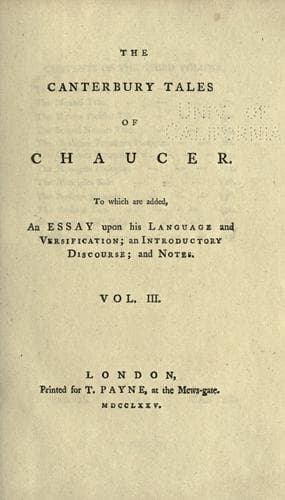
The Canterbury Tales, and Other PoemsChaucer, Geoffrey
ReligionChristian
The Canterbury Tales, and Other Poems
Chaucer, Geoffrey
Chaucer, Geoffrey, -1400; Christian pilgrims and pilgrimages -- Poetry; English poetry -- Middle English, 1100-1500
Off went the skin an handbreadth all about.
The hote culter burned so his tout*, *breech
That for the smart he weened* he would die; *thought
As he were wood*, for woe he gan to cry, *mad
“Help! water, water, help for Godde’s heart!”
This carpenter out of his slumber start,
And heard one cry “Water,” as he were wood*, *mad
And thought, “Alas! now cometh Noe’s flood.”
He sat him up withoute wordes mo’
And with his axe he smote the cord in two;
And down went all; he found neither to sell
Nor bread nor ale, till he came to the sell*, *threshold <41>
Upon the floor, and there in swoon he lay.
Up started Alison and Nicholay,
And cried out an “harow!” <15> in the street.
The neighbours alle, bothe small and great
In ranne, for to gauren* on this man, *stare
That yet in swoone lay, both pale and wan:
For with the fall he broken had his arm.
But stand he must unto his owen harm,
For when he spake, he was anon borne down
With Hendy Nicholas and Alisoun.
They told to every man that he was wood*; *mad
He was aghaste* so of Noe’s flood, *afraid
Through phantasy, that of his vanity
He had y-bought him kneading-tubbes three,
And had them hanged in the roof above;
And that he prayed them for Godde’s love
To sitten in the roof for company.
The folk gan laughen at his phantasy.
Into the roof they kyken* and they gape, *peep, look.
And turned all his harm into a jape*. *jest
For whatsoe’er this carpenter answer’d,
It was for nought, no man his reason heard.
With oathes great he was so sworn adown,
That he was holden wood in all the town.
For every clerk anon right held with other;
They said, “The man was wood, my leve* brother;” *dear
And every wight gan laughen at his strife.
Thus swived* was the carpentere’s wife, *enjoyed
For all his keeping* and his jealousy; *care
And Absolon hath kiss’d her nether eye;
And Nicholas is scalded in the tout.
This tale is done, and God save all the rout*. *company
Notes to the Miller’s Tale
1. Almagest: The book of Ptolemy the astronomer, which
formed the canon of astrological science in the middle ages.
2. Astrolabe: “Astrelagour,” “astrelabore”; a mathematical
instrument for taking the altitude of the sun or stars.
3. “Augrim” is a corruption of algorithm, the Arabian term for
numeration; “augrim stones,” therefore were probably marked
with numerals, and used as counters.
4. Angelus ad virginem: The Angel’s salutation to Mary; Luke i.
28. It was the “Ave Maria” of the Catholic Church service.
Public-domain text, read in full here on John Shaqi.
Reviews
Reviews
No reviews yet
Be the first to share your thoughts on this work.
Elsewhere in the archive
Join the Discussion
Join the discussion
Sign in to leave a comment or review.
Sign InorCreate an account