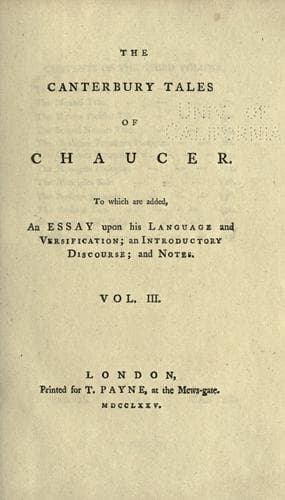
The Canterbury Tales, and Other PoemsChaucer, Geoffrey
ReligionChristian
The Canterbury Tales, and Other Poems
Chaucer, Geoffrey
Chaucer, Geoffrey, -1400; Christian pilgrims and pilgrimages -- Poetry; English poetry -- Middle English, 1100-1500
5. Cato: Though Chaucer may have referred to the famous
Censor, more probably the reference is merely to the “Moral
Distichs,” which go under his name, though written after his
time; and in a supplement to which the quoted passage may be
found.
6. Barm-cloth: apron; from Anglo-Saxon “barme,” bosom or
lap.
7. Volupere: Head-gear, kerchief; from French, “envelopper,”
to wrap up.
8. Popelet: Puppet; but chiefly; young wench.
9. Noble: nobles were gold coins of especial purity and
brightness; “Ex auro nobilissimi, unde nobilis vocatus,” (made
from the noblest (purest) gold, and therefore called nobles) says
Vossius.
10. Yern: Shrill, lively; German, “gern,” willingly, cheerfully.
11. Braket: bragget, a sweet drink made of honey, spices, &c.
In some parts of the country, a drink made from honeycomb,
after the honey is extracted, is still called “bragwort.”
12. Piggesnie: a fond term, like “my duck;” from Anglo-Saxon,
“piga,” a young maid; but Tyrwhitt associates it with the Latin,
“ocellus,” little eye, a fondling term, and suggests that the “pigs-
eye,” which is very small, was applied in the same sense.
Davenport and Butler both use the word pigsnie, the first for
“darling,” the second literally for “eye;” and Bishop Gardner,
“On True Obedience,” in his address to the reader, says: “How
softly she was wont to chirpe him under the chin, and kiss him;
how prettily she could talk to him (how doth my sweet heart,
what saith now pig’s-eye).”
13. Oseney: A once well-known abbey near Oxford.
14. Trave: travis; a frame in which unruly horses were shod.
15. Harow and Alas: Haro! was an old Norman cry for redress
or aid. The “Clameur de Haro” was lately raised, under peculiar
circumstances, as the prelude to a legal protest, in Jersey.
16. His shoes were ornamented like the windows of St. Paul’s,
especially like the old rose-window.
17. Rise: Twig, bush; German, “Reis,” a twig; “Reisig,” a copse.
18. Chaucer satirises the dancing of Oxford as he did the French
of Stratford at Bow.
19. Shot window: A projecting or bow window, whence it was
possible shoot at any one approaching the door.
20. Piment: A drink made with wine, honey, and spices.
21. Because she was town-bred, he offered wealth, or money
reward, for her love.
22. Parish-clerks, like Absolon, had leading parts in the
mysteries or religious plays; Herod was one of these parts,
which may have been an object of competition among the
amateurs of the period.
23 .”The nighe sly maketh oft time the far lief to be loth”: a
proverb; the cunning one near at hand oft makes the loving one
afar off to be odious.
24. Kyked: Looked; “keek” is still used in some parts in the
sense of “peep.”
25. Saint Frideswide was the patroness of a considerable priory
at Oxford, and held there in high repute.
26. Plato, in his “Theatetus,” tells this story of Thales; but
it has since appeared in many other forms.
27. Crouche: protect by signing the sign of the cross.
Public-domain text, read in full here on John Shaqi.
Reviews
Reviews
No reviews yet
Be the first to share your thoughts on this work.
Elsewhere in the archive
Join the Discussion
Join the discussion
Sign in to leave a comment or review.
Sign InorCreate an account