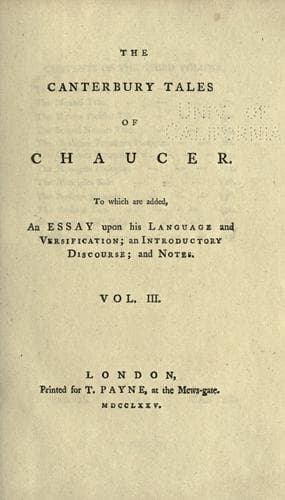
The Canterbury Tales, and Other PoemsChaucer, Geoffrey
ReligionChristian
The Canterbury Tales, and Other Poems
Chaucer, Geoffrey
Chaucer, Geoffrey, -1400; Christian pilgrims and pilgrimages -- Poetry; English poetry -- Middle English, 1100-1500
28. Forlore: lost; german, “verloren.”
29. Him that harried Hell: Christ who wasted or subdued hell: in
the middle ages, some very active exploits against the prince of
darkness and his powers were ascribed by the monkish tale-
tellers to the saviour after he had “descended into hell.”
30. According to the old mysteries, Noah’s wife refused to
come into the ark, and bade her husband row forth and get him
a new wife, because he was leaving her gossips in the town to
drown. Shem and his brothers got her shipped by main force;
and Noah, coming forward to welcome her, was greeted with a
box on the ear.
31. “Him had been lever, I dare well undertake,
At thilke time, than all his wethers black,
That she had had a ship herself alone.”
i.e.
“At that time he would have given all his black wethers, if she
had had an ark to herself.”
32. “Clum,” like “mum,” a note of silence; but otherwise
explained as the humming sound made in repeating prayers;
from the Anglo-Saxon, “clumian,” to mutter, speak in an under-
tone, keep silence.
33. Curfew-time: Eight in the evening, when, by the law of
William the Conqueror, all people were, on ringing of a bell, to
extinguish fire and candle, and go to rest; hence the word
curfew, from French, “couvre-feu,” cover-fire.
34. Absolon chewed grains: these were grains of Paris, or
Paradise; a favourite spice.
35. Under his tongue a true love he bare: some sweet herb;
another reading, however, is “a true love-knot,” which may
have been of the nature of a charm.
36. The two lines within brackets are not in most of the
editions: they are taken from Urry; whether he supplied them or
not, they serve the purpose of a necessary explanation.
37. Gay girl: As applied to a young woman of light manners,
this euphemistic phrase has enjoyed a wonderful vitality.
38. Viretote: Urry reads “meritote,” and explains it from
Spelman as a game in which children made themselves giddy by
whirling on ropes. In French, “virer” means to turn; and the
explanation may, therefore, suit either reading. In modern slang
parlance, Gerveis would probably have said, “on the rampage,”
or “on the swing” — not very far from Spelman’s rendering.
39. He had more tow on his distaff: a proverbial saying: he was
playing a deeper game, had more serious business on hand.
40. Ere: before; German, “eher.”
41. Sell: sill of the door, threshold; French, “seuil,” Latin,
“solum,” the ground.
THE REEVE’S TALE.
THE PROLOGUE.
Public-domain text, read in full here on John Shaqi.
Reviews
Reviews
No reviews yet
Be the first to share your thoughts on this work.
Elsewhere in the archive
Join the Discussion
Join the discussion
Sign in to leave a comment or review.
Sign InorCreate an account