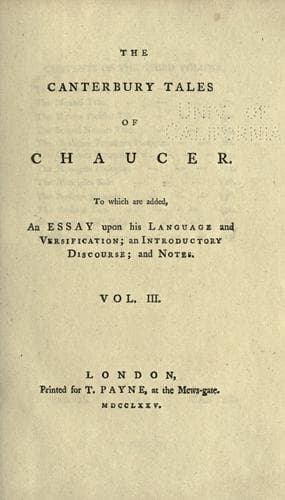
The Canterbury Tales, and Other PoemsChaucer, Geoffrey
ReligionChristian
The Canterbury Tales, and Other Poems
Chaucer, Geoffrey
Chaucer, Geoffrey, -1400; Christian pilgrims and pilgrimages -- Poetry; English poetry -- Middle English, 1100-1500
To find a staff; and she start up also,
And knew the estres* better than this John, *apartment
And by the wall she took a staff anon:
And saw a little shimmering of a light,
For at an hole in shone the moone bright,
And by that light she saw them both the two,
But sickerly* she wist not who was who, *certainly
But as she saw a white thing in her eye.
And when she gan this white thing espy,
She ween’d* the clerk had wear’d a volupere**; *supposed **night-cap
And with the staff she drew aye nere* and nere*, *nearer
And ween’d to have hit this Alein at the full,
And smote the miller on the pilled* skull; *bald
That down he went, and cried,” Harow! I die.”
These clerkes beat him well, and let him lie,
And greithen* them, and take their horse anon, *make ready, dress
And eke their meal, and on their way they gon:
And at the mill door eke they took their cake
Of half a bushel flour, full well y-bake.
Thus is the proude miller well y-beat,
And hath y-lost the grinding of the wheat;
And payed for the supper *every deal* *every bit
Of Alein and of John, that beat him well;
His wife is swived, and his daughter als*; *also
Lo, such it is a miller to be false.
And therefore this proverb is said full sooth,
“*Him thar not winnen well* that evil do’th, *he deserves not to gain*
A guiler shall himself beguiled be:”
And God that sitteth high in majesty
Save all this Company, both great and smale.
Thus have I quit* the Miller in my tale. *made myself quits with
Notes to the Reeve’s Tale
1. The incidents of this tale were much relished in the Middle
Ages, and are found under various forms. Boccaccio has told
them in the ninth day of his “Decameron”.
2. Camuse: flat; French “camuse”, snub-nosed.
3. Gite: gown or coat; French “jupe.”
4. Soler Hall: the hall or college at Cambridge with the gallery
or upper storey; supposed to have been Clare Hall.
(Transcribers note: later commentators identify it with King’s
Hall, now merged with Trinity College)
5. Manciple: steward; provisioner of the hall. See also note 47
to the prologue to the Tales.
6. Testif: headstrong, wild-brained; French, “entete.”
7. Strother: Tyrwhitt points to Anstruther, in Fife: Mr Wright
to the Vale of Langstroth, in the West Riding of Yorkshire.
Chaucer has given the scholars a dialect that may have belonged
to either district, although it more immediately suggests the
more northern of the two.
(Transcribers note: later commentators have identified it with a
now vanished village near Kirknewton in Northumberland.
There was a well-known Alein of Strother in Chaucer’s
lifetime.)
8. Wanges: grinders, cheek-teeth; Anglo-Saxon, “Wang,” the
cheek; German, “Wange.”
9. See note 1 to the Prologue to the Reeves Tale
Public-domain text, read in full here on John Shaqi.
Reviews
Reviews
No reviews yet
Be the first to share your thoughts on this work.
Elsewhere in the archive
Join the Discussion
Join the discussion
Sign in to leave a comment or review.
Sign InorCreate an account