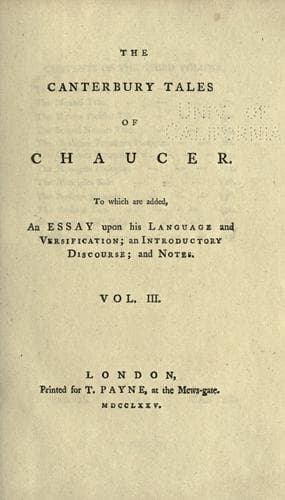
The Canterbury Tales, and Other PoemsChaucer, Geoffrey
ReligionChristian
The Canterbury Tales, and Other Poems
Chaucer, Geoffrey
Chaucer, Geoffrey, -1400; Christian pilgrims and pilgrimages -- Poetry; English poetry -- Middle English, 1100-1500
10. In the “Cento Novelle Antiche,” the story is told of a mule,
which pretends that his name is written on the bottom of his
hind foot. The wolf attempts to read it, the mule kills him with a
kick in the forehead; and the fox, looking on, remarks that
“every man of letters is not wise.” A similar story is told in
“Reynard the Fox.”
11. Levesell: an arbour; Anglo-Saxon, “lefe-setl,” leafy seat.
12. Noth: business; German, “Noth,” necessity.
13. Bathe: both; Scottice, “baith.”
14. Capel: horse; Gaelic, “capall;” French, “cheval;” Italian,
“cavallo,” from Latin, “caballus.”
15. Make a clerkes beard: cheat a scholar; French, “faire la
barbe;” and Boccaccio uses the proverb in the same sense.
16. “Gar” is Scotch for “cause;” some editions read, however,
“get us some”.
17. Chalons: blankets, coverlets, made at Chalons in France.
18. Crock: pitcher, cruse; Anglo-Saxon, “crocca;” German,
“krug;” hence “crockery.”
19. Dwale: night-shade, Solanum somniferum, given to cause
sleep.
20. Burdoun: bass; “burden” of a song. It originally means the
drone of a bagpipe; French, “bourdon.”
21. Compline: even-song in the church service; chorus.
22. Ferly: strange. In Scotland, a “ferlie” is an unwonted or
remarkable sight.
23. A furlong way: As long as it might take to walk a furlong.
24. Cockenay: a term of contempt, probably borrowed from the
kitchen; a cook, in base Latin, being termed “coquinarius.”
compare French “coquin,” rascal.
25. Unhardy is unsely: the cowardly is unlucky; “nothing
venture, nothing have;” German, “unselig,” unhappy.
26. Holy cross of Bromeholm: A common adjuration at that
time; the cross or rood of the priory of Bromholm, in Norfolk,
was said to contain part of the real cross and therefore held in
high esteem.
27. In manus tuas: Latin, “in your hands”.
THE COOK’S TALE.
THE PROLOGUE.
THE Cook of London, while the Reeve thus spake,
For joy he laugh’d and clapp’d him on the back:
“Aha!” quoth he, “for Christes passion,
This Miller had a sharp conclusion,
Upon this argument of herbergage.* *lodging
Well saide Solomon in his language,
Bring thou not every man into thine house,
For harbouring by night is perilous.
*Well ought a man avised for to be* *a man should take good heed*
Whom that he brought into his privity.
I pray to God to give me sorrow and care
If ever, since I highte* Hodge of Ware, *was called
Heard I a miller better *set a-work*; *handled
He had a jape* of malice in the derk. *trick
But God forbid that we should stinte* here, *stop
And therefore if ye will vouchsafe to hear
A tale of me, that am a poore man,
I will you tell as well as e’er I can
A little jape that fell in our city.”
Public-domain text, read in full here on John Shaqi.
Reviews
Reviews
No reviews yet
Be the first to share your thoughts on this work.
Elsewhere in the archive
Join the Discussion
Join the discussion
Sign in to leave a comment or review.
Sign InorCreate an account