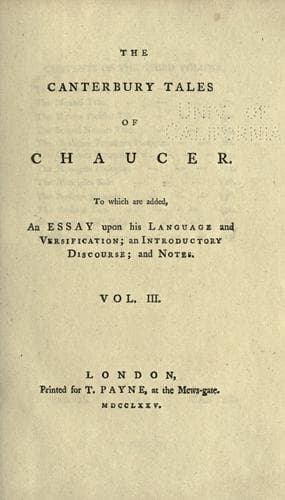
The Canterbury Tales, and Other PoemsChaucer, Geoffrey
ReligionChristian
The Canterbury Tales, and Other Poems
Chaucer, Geoffrey
Chaucer, Geoffrey, -1400; Christian pilgrims and pilgrimages -- Poetry; English poetry -- Middle English, 1100-1500
The plaint of Diane, and of Hermion,
Of Ariadne, and Hypsipile;
The barren isle standing in the sea;
The drown’d Leander for his fair Hero;
The teares of Helene, and eke the woe
Of Briseis, and Laodamia;
The cruelty of thee, Queen Medea,
Thy little children hanging by the halse*, *neck
For thy Jason, that was of love so false.
Hypermnestra, Penelop’, Alcest’,
Your wifehood he commendeth with the best.
But certainly no worde writeth he
Of *thilke wick’* example of Canace, *that wicked*
That loved her own brother sinfully;
(Of all such cursed stories I say, Fy),
Or else of Tyrius Apollonius,
How that the cursed king Antiochus
Bereft his daughter of her maidenhead;
That is so horrible a tale to read,
When he her threw upon the pavement.
And therefore he, *of full avisement*, *deliberately, advisedly*
Would never write in none of his sermons
Of such unkind* abominations; *unnatural
Nor I will none rehearse, if that I may.
But of my tale how shall I do this day?
Me were loth to be liken’d doubteless
To Muses, that men call Pierides<6>
(Metamorphoseos <7> wot what I mean),
But natheless I recke not a bean,
Though I come after him with hawebake*; *lout <8>
I speak in prose, and let him rhymes make.”
And with that word, he with a sober cheer
Began his tale, and said as ye shall hear.
Notes to the Prologue to The Man of Law’s Tale
1. Plight: pulled; the word is an obsolete past tense from
“pluck.”
2. No more than will Malkin’s maidenhead: a proverbial saying;
which, however, had obtained fresh point from the Reeve’s
Tale, to which the host doubtless refers.
3. De par dieux jeo asente: “by God, I agree”. It is
characteristic that the somewhat pompous Sergeant of Law
should couch his assent in the semi-barbarous French, then
familiar in law procedure.
4. Ceyx and Alcyon: Chaucer treats of these in the introduction
to the poem called “The Book of the Duchess.” It relates to the
death of Blanche, wife of John of Gaunt, Duke of Lancaster, the
poet’s patron, and afterwards his connexion by marriage.
5. The Saintes Legend of Cupid: Now called “The Legend of
Good Women”. The names of eight ladies mentioned here are
not in the “Legend” as it has come down to us; while those of
two ladies in the “legend” — Cleopatra and Philomela — are her
omitted.
6. Not the Muses, who had their surname from the place near
Mount Olympus where the Thracians first worshipped them; but
the nine daughters of Pierus, king of Macedonia, whom he
called the nine Muses, and who, being conquered in a contest
with the genuine sisterhood, were changed into birds.
7. Metamorphoseos: Ovid’s.
8. Hawebake: hawbuck, country lout; the common proverbial
phrase, “to put a rogue above a gentleman,” may throw light on
the reading here, which is difficult.
THE TALE. <1>
Public-domain text, read in full here on John Shaqi.
Reviews
Reviews
No reviews yet
Be the first to share your thoughts on this work.
Elsewhere in the archive
Join the Discussion
Join the discussion
Sign in to leave a comment or review.
Sign InorCreate an account