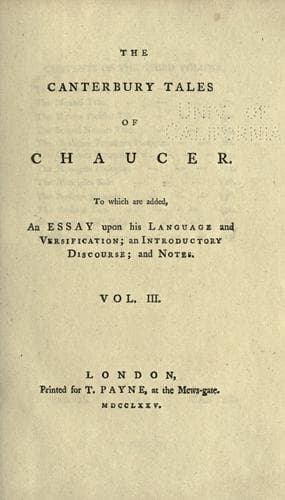
The Canterbury Tales, and Other PoemsChaucer, Geoffrey
ReligionChristian
The Canterbury Tales, and Other Poems
Chaucer, Geoffrey
Chaucer, Geoffrey, -1400; Christian pilgrims and pilgrimages -- Poetry; English poetry -- Middle English, 1100-1500
Our Hoste saw well that the brighte sun
Th’ arc of his artificial day had run
The fourthe part, and half an houre more;
And, though he were not deep expert in lore,
He wist it was the eight-and-twenty day
Of April, that is messenger to May;
And saw well that the shadow of every tree
Was in its length of the same quantity
That was the body erect that caused it;
And therefore by the shadow he took his wit*, *knowledge
That Phoebus, which that shone so clear and bright,
Degrees was five-and-forty clomb on height;
And for that day, as in that latitude,
It was ten of the clock, he gan conclude;
And suddenly he plight* his horse about. *pulled <1>
“Lordings,” quoth he, “I warn you all this rout*, *company
The fourthe partie of this day is gone.
Now for the love of God and of Saint John
Lose no time, as farforth as ye may.
Lordings, the time wasteth night and day,
And steals from us, what privily sleeping,
And what through negligence in our waking,
As doth the stream, that turneth never again,
Descending from the mountain to the plain.
Well might Senec, and many a philosopher,
Bewaile time more than gold in coffer.
For loss of chattels may recover’d be,
But loss of time shendeth* us, quoth he. *destroys
It will not come again, withoute dread,*
No more than will Malkin’s maidenhead,<2>
When she hath lost it in her wantonness.
Let us not moulde thus in idleness.
“Sir Man of Law,” quoth he, “so have ye bliss,
Tell us a tale anon, as forword* is. *the bargain
Ye be submitted through your free assent
To stand in this case at my judgement.
Acquit you now, and *holde your behest*; *keep your promise*
Then have ye done your devoir* at the least.” *duty
“Hoste,” quoth he, “de par dieux jeo asente; <3>
To breake forword is not mine intent.
Behest is debt, and I would hold it fain,
All my behest; I can no better sayn.
For such law as a man gives another wight,
He should himselfe usen it by right.
Thus will our text: but natheless certain
I can right now no thrifty* tale sayn, *worthy
But Chaucer (though he *can but lewedly* *knows but imperfectly*
On metres and on rhyming craftily)
Hath said them, in such English as he can,
Of olde time, as knoweth many a man.
And if he have not said them, leve* brother, *dear
In one book, he hath said them in another
For he hath told of lovers up and down,
More than Ovide made of mentioun
In his Epistolae, that be full old.
Why should I telle them, since they he told?
In youth he made of Ceyx and Alcyon,<4>
And since then he hath spoke of every one
These noble wives, and these lovers eke.
Whoso that will his large volume seek
Called the Saintes’ Legend of Cupid:<5>
There may he see the large woundes wide
Of Lucrece, and of Babylon Thisbe;
The sword of Dido for the false Enee;
The tree of Phillis for her Demophon;
Public-domain text, read in full here on John Shaqi.
Reviews
Reviews
No reviews yet
Be the first to share your thoughts on this work.
Elsewhere in the archive
Join the Discussion
Join the discussion
Sign in to leave a comment or review.
Sign InorCreate an account